Google Visitor Experience at the Googleplex: Café, Store & What to Expect
Google Headquarters (Googleplex) Visitor Guide: The Café, the Store, and a Little Silicon Valley History
Say “Silicon Valley” and most people picture a place packed with world-famous tech companies.
And that is pretty much what it is — several of the best-known tech headquarters in the world sit here, and the whole area has a real buzz to it.
These are working corporate campuses, so there’s a limit to how much of them you can actually wander. Some companies, though, keep facilities open specifically for visitors.
This time we’re looking at the store and café Google runs for visitors, right next to its enormous headquarters.
Worth a look if you’re putting together a Silicon Valley itinerary.
1. What Is Silicon Valley?
Silicon Valley is the area centered on the Santa Clara Valley, at the southern end of the San Francisco Bay in California, and it holds one of the largest concentrations of the technology industry anywhere in the world.
The name combines “silicon,” the main material used in semiconductors, with the Santa Clara Valley, which used to be farm country. It caught on during the semiconductor boom of the 1970s.
These days it goes well beyond chipmaking: software, cloud, AI, biotech, cleantech, and space, with startups and giants sharing one ecosystem.
Geographically it sits about a 45-minute drive south of San Francisco. The rough boundaries run from around Redwood City in the north to San Jose in the south, Fremont to the east, and the Santa Cruz Mountains behind Stanford to the west.
Around 3.1 million people live in the area, and it keeps getting more diverse as skilled workers move in.
Mountain View, one of the main cities, is where Google is headquartered. With roughly 82,000 residents as of 2023 it’s fairly compact by Silicon Valley standards, but household income there runs well above the national average.
For example, U.S. Census figures (American Community Survey) put the median household income in the city of Mountain View at $179,917.
The national median household income for that same year, 2023, was $80,610.
That’s a gap of roughly $99,300 — about 2.2 times the national figure, or +123%.
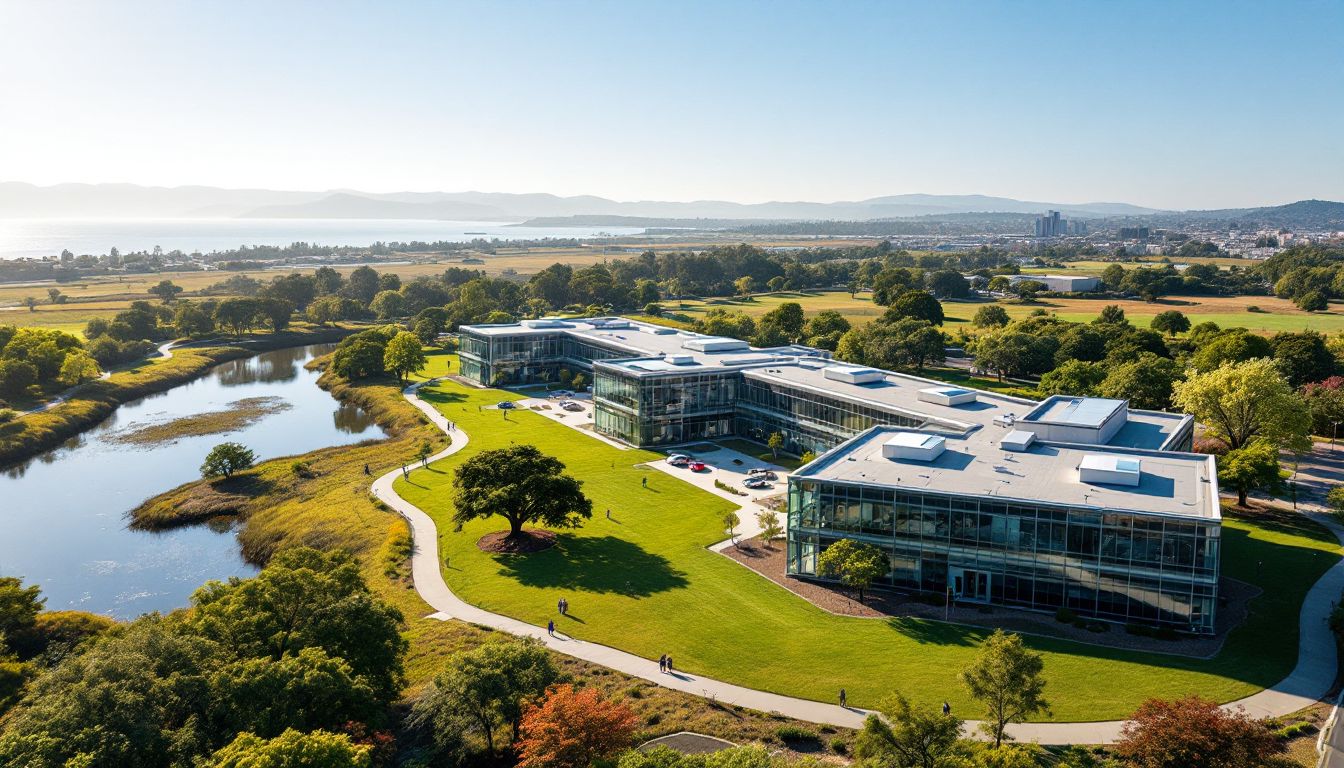
Along the bay you’ll also find Google’s Charleston Park and Shoreline Park, built on restored wetlands, which gives the area its particular look: tech campuses sitting right next to open nature.
(Bonus) How Silicon Valley Came to Be
Long before any of this, the area was orchard country known as the “Valley of Heart’s Delight,” covered in prune and apricot trees.
In the mid-20th century, Stanford University set up an industrial park on its own land — what is now Stanford Research Park — to draw research-driven companies in close to the campus.
One of its tenants, Hewlett-Packard (HP), became the symbol of the garage startup, and the high-tech cluster here is usually traced back to that period.
In 1956, William Shockley set up a semiconductor company here, one of the first in the area to work in silicon.
The group that spun out of it, the “Traitorous Eight,” went on to found Fairchild Semiconductor, which in turn led to Intel and the rest of the chip industry that grew up here.
In the 1970s, Apple came out of Steve Jobs and Steve Wozniak’s home garage and opened the personal computer era.
Through the 1980s and 90s, venture capital grew quickly and the NASDAQ listing boom took off.
Networking and software companies like Cisco, Sun Microsystems, and Oracle rose to the front.
In the 2000s, internet services led by Google, Facebook (now Meta), and Netflix grew fast.
That period cemented the region’s place as a center of the global economy.
The 2010s brought the full expansion of smartphones and cloud computing.
Apple drove the iPhone ecosystem while Google expanded Android and its cloud platform.
On the chip side, NVIDIA put GPUs to work on AI computation and laid the groundwork for the AI boom.
In electric vehicles, Tesla — headquartered in Palo Alto at the time — drew attention for building cars software-first.
Then the 2020s brought the wave of generative AI. Google introduced large language models running on its own TPUs, and NVIDIA’s AI GPUs drove semiconductor demand.
In self-driving, Alphabet’s Waymo expanded its robotaxi service into everyday operation, and the wider push into next-generation mobility accelerated with it.
All of that history built up into what the area is known for: a tolerance for failure, flat organizations, fast decisions, and a social fabric that takes in people from everywhere.
Walking through a place where that history and today’s innovation sit side by side is what makes a Silicon Valley visit more than a tour of “the town where the IT companies are.”
2. What Is Google LLC?
Google LLC is one of the world’s largest technology companies, with a product range that spans online advertising, search, cloud, AI, and hardware.
It operates under its parent company, Alphabet Inc., which reports the group’s financial results.
Its headquarters is the Googleplex in Mountain View, California — a sprawling campus that holds numerous R&D facilities alongside the Google Visitor Experience, which is open to the public.
The company’s stated mission is “to organize the world’s information and make it universally accessible and useful.”
It still holds around 90% of the search market — a commanding lead.
2-1. How Google Got Started
The story starts in 1995, when Sergey Brin — then leading campus tours at Stanford — showed a prospective student named Larry Page around.
In 1996 the two began a joint research project called “BackRub” that evaluated the link structure of the web, the prototype of what became the PageRank algorithm.
They registered google.com on September 15, 1997, taking the company name from a misspelling of googol, the enormous number 10¹⁰⁰.
On September 4, 1998 they formally founded Google Inc., funded by a $100,000 check from Sun Microsystems co-founder Andy Bechtolsheim.
The first office was Susan Wojcicki’s garage at her home in Menlo Park, and by early 1999 the company was handling 50,000 searches a day.

2-2. A Timeline of Google’s Growth
● 2000 — Launched AdWords, the keyword-linked advertising product that turned search into a business.
● 2002 — Started Google News, an automated news aggregator, moving into the media space.
● 2004 — Launched Gmail with 1GB of free storage, far more than competitors offered at the time.
● August 2004 — Went public at $85 a share, raising $1.67 billion.
● 2005 — Released Google Maps and acquired Android, strengthening its mobile platform strategy.
● 2006 — Acquired YouTube for $1.65 billion and moved seriously into video advertising.
● 2008 — Released its own browser, Google Chrome, which would later take the largest share worldwide.
● 2015 — Created the holding company Alphabet Inc., with Google reorganized as its main subsidiary.
● Early 2020s — Waymo, Alphabet’s self-driving arm, began carrying the public in fully driverless vehicles, putting the mobility side of the business in the spotlight.
● 2023 — Released the large language model Gemini, declaring itself a full participant in the generative AI race.
● 2024 — Rolled out AI Overviews, which puts AI summaries directly into search results.
● April 2025 — Reported first-quarter revenue of $90.2 billion and net income of $34.5 billion, and announced annual capital expenditure of $75 billion on AI infrastructure.
2-3. Where Google Is Today
Google has folded generative AI into search, advertising, and cloud across the board, using AI Overviews and a Gemini-based “AI Mode” to push search engagement higher.
On the hardware side it keeps expanding its lineup of devices built around dedicated AI chips, pushing a strategy that ties devices and services together.
3. What Are the Googleplex and the Google Visitor Experience?
The Googleplex is the collective name for the headquarters campus of Google and its parent, Alphabet.
The name blends “Google” and “complex,” with a nod to googolplex — 10 to the power of a googol — built into it.
The site runs to more than 2 million square feet, with office buildings and green space scattered across it.
You can’t get inside the office buildings themselves without an employee badge or an invitation from someone who has one.
What visitors can walk into is the part that’s open to the public: the Google Visitor Experience.
That’s where you’ll find the Google Store and Cafe @ Mountain View, and anyone can go in.
View this post on Instagram
4. The Google Store
The Google Store sits inside the Google Visitor Experience and sells Google products.
There’s a good spread of official merchandise from the Google, YouTube, and Android brands. T-shirts run around $25, embroidered caps about $30, and ceramic mugs somewhere around $15.
Checkout takes major credit cards, and payment options can change, so check the store’s current policy if you’re counting on a particular card or mobile wallet.
Receipts are typically emailed rather than printed.
New Arrivals
Discover our newest arrivals—available now!



5. Cafe @ Mountain View
Cafe @ Mountain View is Google’s first restaurant and café space open to the general public, built into the Google Visitor Experience.
Google describes the kitchen as working with sustainably sourced, locally harvested ingredients.
The food is legitimately good, so it’s worth sitting down for a proper meal while you’re there!
For a look at the actual food, see the Instagram post below.
View this post on Instagram
6. Google Bikes (G-Bikes)
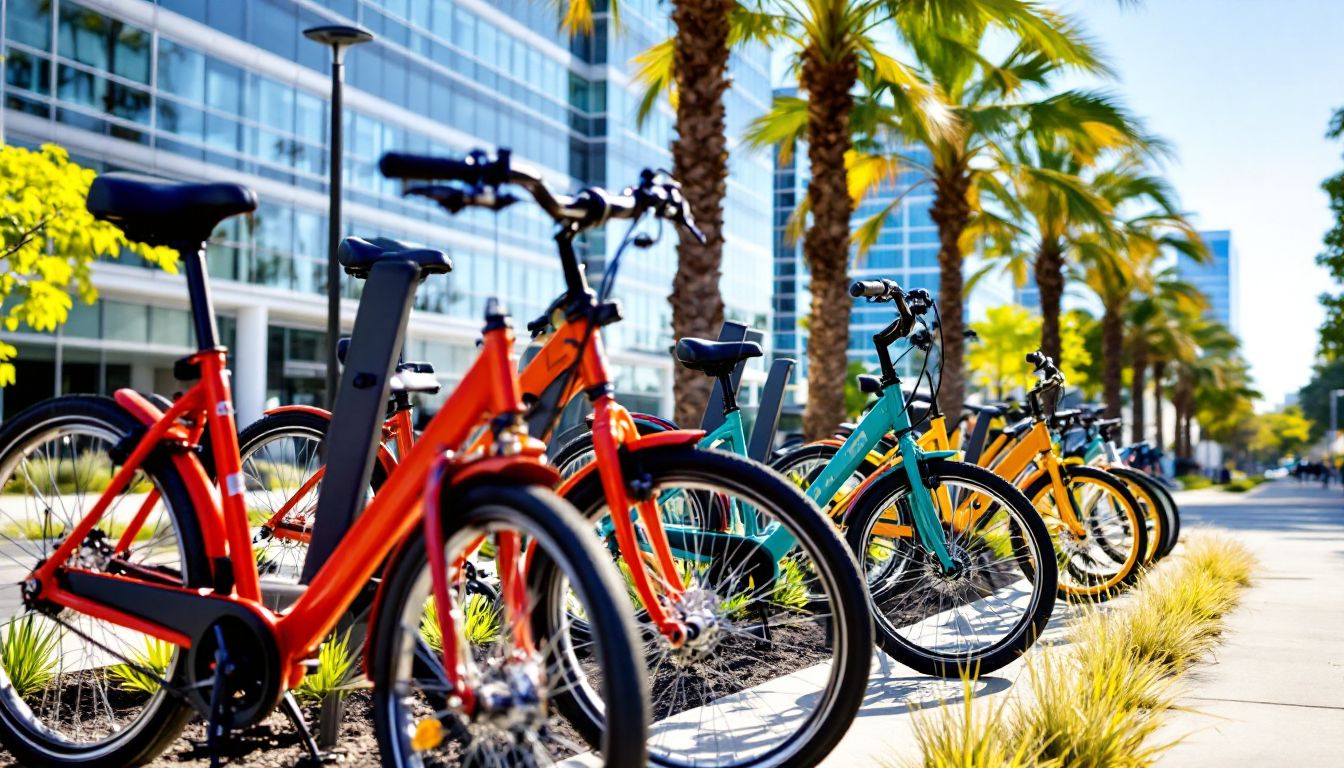
Google Bikes are the free shared bicycles employees use to get around the Googleplex and the surrounding campuses, easy to spot by their multicolored stripes.
The frame is lightweight aluminum alloy, with 26-inch wheels, a three-speed internal hub, and a step-through shape that anyone can swing a leg over.
There’s no brand logo on them. Instead the whole frame is painted in Google’s four colors — blue, red, yellow, and green — which makes them a friendly visual landmark on campus.
What began as a small pilot has grown into a fleet spread across the Mountain View and Sunnyvale campuses.
None of them are locked. Employees grab one from the nearest rack and leave it at a stand near wherever they’re going — a free-float setup.
Google has pointed to the bikes, used in place of shuttle buses and electric carts for short hops, as a way of cutting both travel time and emissions across the campus.
They’re for employees getting around the campus, not a bike share you can borrow from as a visitor.
7. Nearby Spots Worth Adding to Your Day
Here are two places that are easy to tack on once you’ve had your fill of the Google Visitor Experience.
Both are within about 20 minutes by car, or reachable by public transit plus a walk, which makes them simple to fold into a half-day plan.
7-1. Computer History Museum
This is a seriously fun museum for anyone curious about how computing got to where it is!
It’s at 1401 N Shoreline Blvd in Mountain View, roughly a 10-minute walk from the Google Visitor Experience.
It’s open Wednesday through Sunday, 10 a.m. to 5 p.m., and closed Mondays and Tuesdays.
There’s a general admission fee, with discounted rates for students, seniors, and younger visitors — worth checking the current prices before you head over, since they do change.
The museum has also taken part in Bank of America’s “Museums on Us” program, where showing your card gets you in free on select days.
The largest permanent exhibit, “Revolution: The First 2000 Years of Computing,” lines up more than 1,100 pieces of real hardware in chronological order.
It runs from the ancient abacus to the first-generation iPhone, so simply walking the timeline gives you the whole arc of computing history.
“Chatbots Decoded” is another popular stop, with conversational robots you can talk to and interactive displays tracing the history of AI research.
The CHM Store on the first floor carries museum-only merchandise that makes for good souvenirs.
There’s a café on site too, for a drink and something light.
7-2. Apple Park Visitor Center
This one’s open to the public — a store and a café — right by Apple’s headquarters.
It’s at 10600 N Tantau Ave in Cupertino, about a 20-minute drive from the Googleplex.
There’s a free two-level underground parking garage with EV charging on site, so parking is usually manageable even on a busy weekend afternoon.
Inside the Apple Store you can browse the latest Apple products, and depending on the day there may be an augmented-reality experience or a Vision Pro demo to try.
The café counter next door serves espresso drinks and light bites.
From the rooftop terrace you get the Silicon Valley hills laid out in front of you, with the roof of the ring-shaped headquarters just visible through the trees.
As with Google, the headquarters area itself is off-limits to visitors, but the whole space has that unmistakable Apple polish to it.
If you’re an Apple fan, it’s well worth the stop.
Also check out our full Apple Park Visitor Center guide.
View this post on Instagram
Curious about today’s driver-assistance technology? If your travels also take you through Southern California, our Tesla rental in the LA area lets you experience Tesla’s Full Self-Driving (Supervised) features from the driver’s seat. It’s a driver-assistance system, so you stay in control and attentive the whole time.
8. Final Thoughts
Silicon Valley is one of the world’s great centers of innovation, a place where the past, present, and future of technology all cross paths.
At the heart of the region, the Googleplex and the Google Visitor Experience keep evolving as a hub that connects the surrounding community and visitors to something bigger than one company.
Whether you’re flying in or you already live in California, if Silicon Valley is on your list, go see the Googleplex area for yourself — the sheer scale of the place is the whole point!
One last thing before you go: hours, admission prices, menus, and merchandise all change over time. This guide reflects what we found as of August 2026, so it’s worth checking the official pages for the Google Visitor Experience, the Computer History Museum, and the Apple Park Visitor Center before you head out.
We share plenty of other spots worth visiting on Instagram, so take a look there too.
View this post on Instagram
You May Also Like