Product Positioning in a Crisis: Lessons from Japan’s “Apples That Won’t Fall”
Introduction
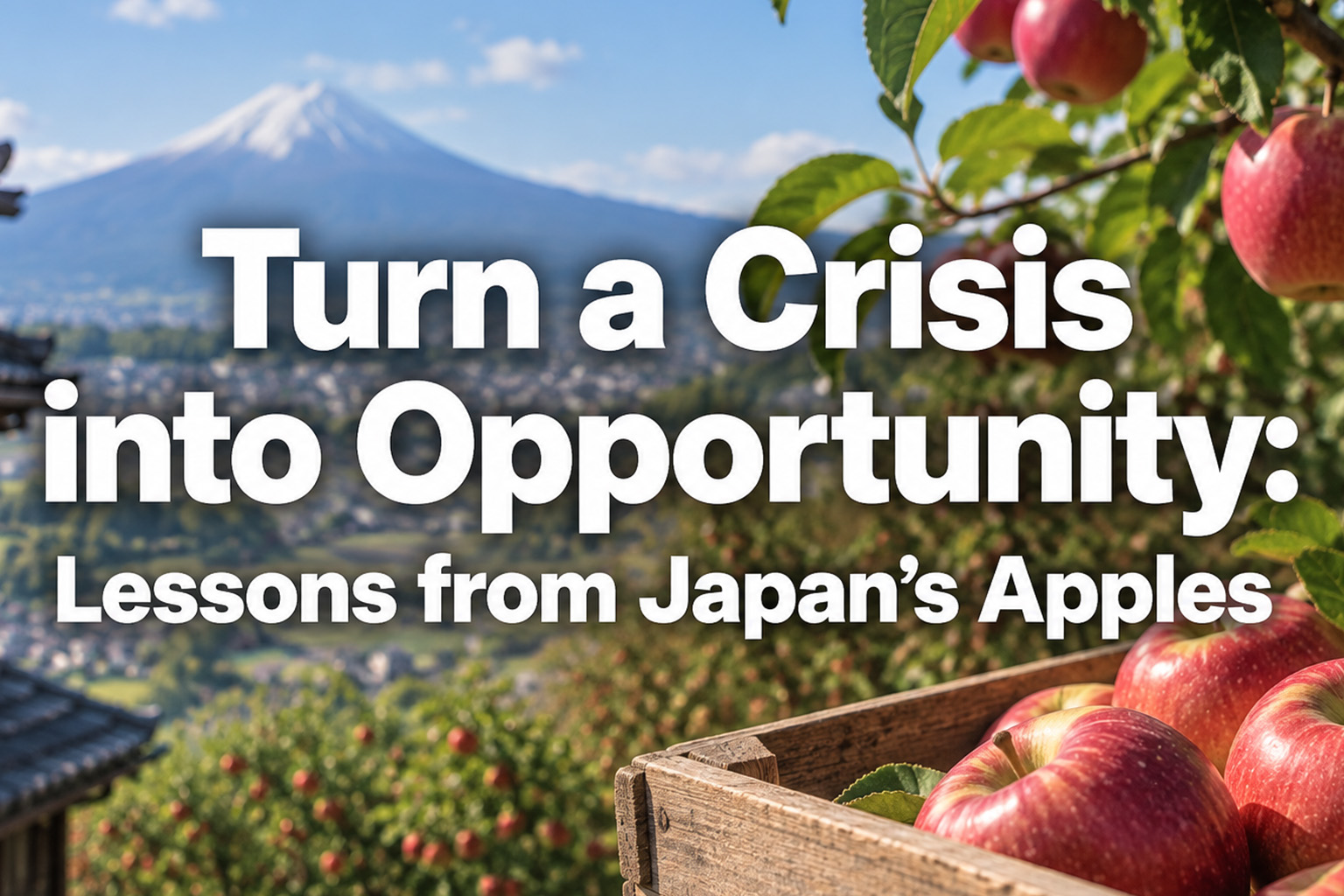
Have you ever heard of a product called Ochinai Ringo? I hadn’t until recently.
The name was given to apples grown in Fujisaki, a town in Aomori Prefecture in northern Japan. The story behind it hits close to home for anyone running a business.
A Quick Guide to Ochinai Ringo
- The name: Ochinai Ringo means “apples that won’t fall.” In Japanese, ringo means “apple,” and ochinai means “won’t fall.”
- The wordplay: Ochiru (“to fall”) can also mean “to fail an exam.” So “won’t fall” suggests “won’t fail” — a wish for exam success.
- Entrance exams: Entrance exams are a common part of high school and college admissions in Japan.
- Shrines and good-luck charms: Some students and their families visit Shinto shrines — places of worship in Japan — to pray for exam success and get good-luck charms.
I want to explore what this story can teach us about surviving a crisis and turning adversity into opportunity. If we treat it simply as a feel-good story, we may miss the most important part.
What stands out to me is the clear thinking behind the strategy and the practical steps that followed. Positive thinking alone wasn’t enough.
Watch the video version here (with English subtitles):
First, What Actually Happened
Ochinai Ringo wasn’t dreamed up single-handedly by the owner of one orchard in Aomori.
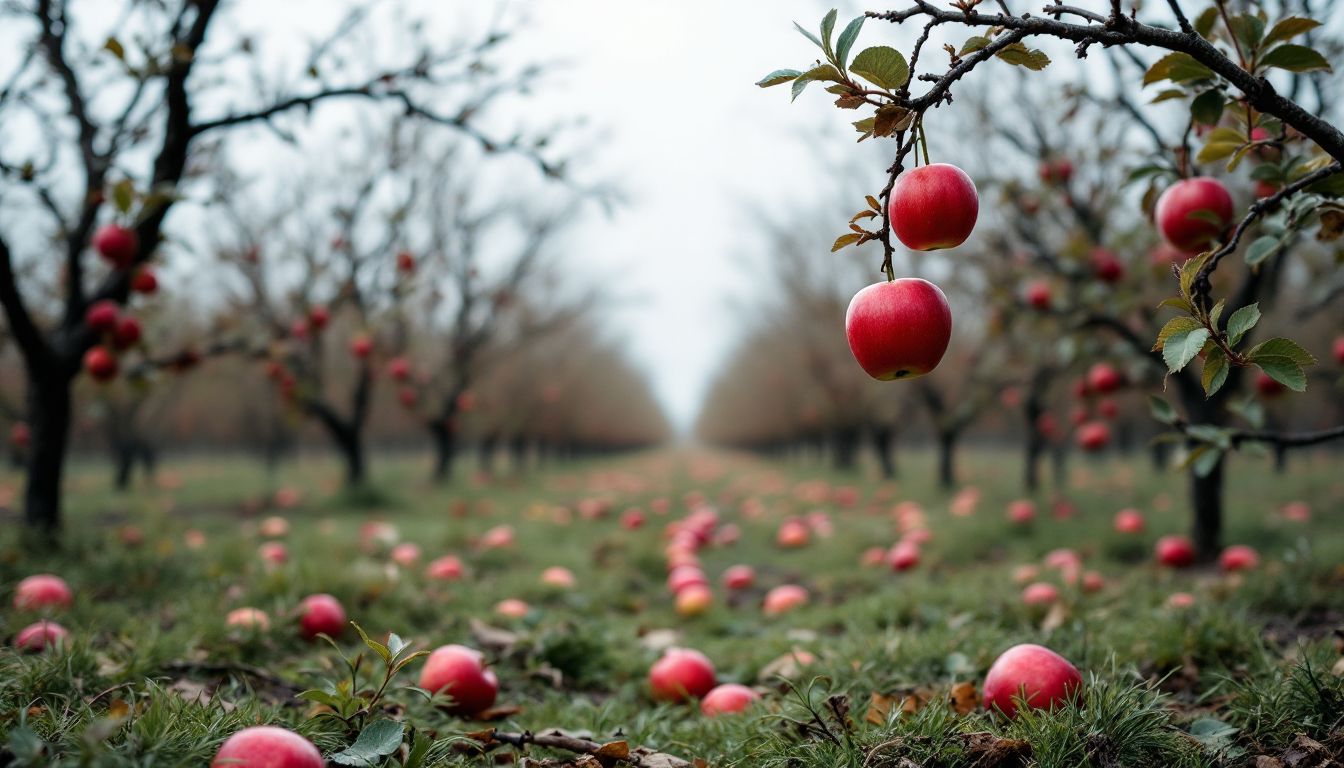
It started with Typhoon No. 19, which hit the apple-growing region of Aomori Prefecture in September 1991 and became known as the “Apple Typhoon.”
In Aomori, the storm reportedly damaged about 388,000 metric tons of apples, with losses estimated at about ¥74.1 billion.
In the middle of all this, several apple growers in the town of Fujisaki teamed up and took the apples that had held on to the trees through the storm, turning them into a good-luck charm for students facing entrance exams: Ochinai Ringo.
The following year, in 1992, they went on sale at shrines across Japan, and in 1993 the effort led to the founding of a company named Ochinai Ringo.
In other words, this is less a comeback story about a single business owner and more a case of local growers working together to redefine the value of what they had left.
What If Your Inventory Were Wiped Out Overnight?
Numbers alone don’t really get the scale across, so I tried picturing it happening to my own company.
My company is in the car business.
Imagine something like a tornado sweeping away every last car we’d just stocked.
Just picturing it makes my stomach drop.
Fruit that was just waiting to be harvested, made unsellable by one night of violent wind.
Spread across an entire growing region, the scale is completely different — but for the growers running those farms, it must have felt something like that.
Still, not every apple was lost.
Some fruit withstood the wind and stayed on the trees.
What they did next is where the story gets really interesting.
The Apples That Stayed on the Tree — Sold as What?

The growers named the apples that had stayed on the trees Ochinai Ringo and sold them as good-luck charms for students taking entrance exams.
The name linked the apples’ survival to the hope students and their families shared: success on those exams.
You Can Change the Reason to Buy Without Changing the Product
The apple’s role as food hadn’t changed. What changed was the meaning attached to it.
It now symbolized both survival through the storm and the hope of passing an exam.
In the same way, customers may value the same product differently depending on the occasion, the recipient, or the story behind it.
Redesigning the reason to buy a product, rather than remaking the product, is one more way to create value.
Why a Shrine and Not a Supermarket or a Produce Stand?
The growers arranged to sell the apples at Shinto shrines across Japan.
That’s where the apples were displayed — not as fruit, but as a good-luck charm.
They picked a place where people with a reason to buy were already gathered.
Match Where You Sell to the Reason People Buy, Not the Product Category
Just because a product is food doesn’t mean a supermarket or grocery store is automatically the best place to sell it.
Someone buying apples for everyday meals and someone buying them as a gift or a symbol of good luck for a student look for them in different places and at different times.
If you can present them as a good-luck charm where people come to pray for exam success, the product’s meaning and the place it’s sold line up naturally.
Choosing your sales channel to fit the moment when customers feel they want something matters as much as designing the product.
Turning an Idea into Results Takes a Team That Can Execute
Even with a great idea, you can’t necessarily develop and sell the product on your own.
Getting it to customers requires people to fill several roles: people to select the products, pack them, explain the product’s story, negotiate with the places that will sell them, and sell them on-site.
In a crisis, you may also have to make decisions and act on them faster than usual.
I believe an idea becomes a business only when individual creativity is backed by a community or organization that can put it into practice.
New Arrivals
Discover our newest arrivals—available now!




















































































In Your Worst Crisis, You Need a Cool Head More Than Optimism
What I take from this story isn’t the result — that a crisis turned into an opportunity — but the steps it took to get there.
In a crisis, the words that tend to slip out are something like, “It’ll be fine. If we just keep doing what we always do, we’ll get through it.”
But that’s probably not what apple country needed that year.
They first needed to take a step back and assess the situation.
Then they needed to take stock of what they still had and build a strategy around it.
That comes first.
In a Crisis, Check What You Still Have, Not Just What You Lost
When you take a big loss, it’s easy to fixate on the sales and inventory you lost.
But to figure out your next move, it’s important to take stock of what you still have: products, equipment, skills, customer relationships, partners, sales channels, and so on.
Even resources that look like they’ve lost their value can take on a different value when you change how they’re used or who they’re for.
To me, recovery starts with asking how the resources you still have could be put to a different use.
That said, I suspect more people than you’d think try to push through on willpower alone.
To be honest, I’m one of them.
When I see the mood on the team sinking, my first instinct is to say, “Let’s just grit our teeth and get through this.”
Optimism and Strategy Have Different Roles
Positive words can help support a team in a tough spot and keep people moving.
But feeling positive isn’t, by itself, a plan for dealing with lost sales or changes in the market.
To turn things around, you need to assess the extent of the damage, the resources you have left, the time you have, and the cash you need, and turn that into concrete action.
It’s important to give each its own role: optimism keeps you moving, strategy decides which way you go.
Don’t Sell an Apple as an Apple

The other lesson is that they didn’t sell the apples as apples.
The moment you put an apple on the shelf as fruit, the going market price comes with it.
When I picture an ordinary apple on a store shelf in Japan, around ¥200 to ¥300 apiece feels like the upper end to me.
As long as your product is judged by the going market price, the market sets your price for you.
To me, a truly original product has to stand apart from those usual price comparisons. It has to be something only you can offer.
Change the Category, and You Change What You’re Compared Against
Sold as ordinary apples, they get compared with other apples on variety, weight, appearance, taste, and market price.
Positioned as a good-luck charm for passing exams, though, they’re no longer compared only on price as fruit.
The story, the sentiment behind the gift, the packaging, and the occasion all become reasons to choose it.
To escape price competition, it’s also important to think about which category you want customers to see your product in, not just the product itself.
Price Depends on the Value Delivered, Not Just the Product
The same apple is bought for a different purpose when it’s sold as everyday food versus as a good-luck charm for a student.
In the second case, the story, the box, the gift appeal, and the place it’s sold all become part of the product along with the apple itself.
So when you think about price, you need to look not just at cost and the usual market rate, but at what customers actually value and are willing to pay for.
A story alone doesn’t justify a higher price, though. Customers still need to understand what makes the product worth it.
What Became of Ochinai Ringo
This wasn’t a one-year thing.
A 2021 local article about the initiative in Fujisaki described it as having continued for about 30 years and noted that apples were also being donated to students preparing for entrance exams.
A Lasting Business Needs Ongoing Demand
A project born to get through a crisis doesn’t automatically become a long-term product.
To last, it needs more than the initial buzz: ongoing demand, a setup that can keep making it, and a way to communicate the brand’s meaning to new customers.
Products with social meaning or ties to their community can also earn support that goes beyond a one-time campaign.
An idea that gets you through a crisis and a business designed to last are two separate problems, and it helps to think about them that way.
* For the current availability of fresh apples and processed products, please check the seller’s latest information.
A Popular Brand Still Needs People to Carry It Forward
More broadly, even a popular product can become difficult to keep producing and selling as producers age, successors become hard to find, or materials and production capacity become harder to secure.
Even when customer demand and brand value remain, if the organization and people supplying it can’t be sustained, sales may have to be scaled back or stopped.
That’s why, for a long-term business, it’s important to plan not only how to sell the product but also for succession: who will make it and keep delivering it in the next generation.
4 Crisis-Response Takeaways from the Apples That Won’t Fall
- Get the facts straight
Sort out where things stand — damage, funds, deadlines — separately from how you feel about it - Take stock of what’s left
List everything you can still use: products, equipment, people, customers, sales channels - Redefine the value
Look at your product again in terms of a different use, meaning, or customer group - Sell where customers have a reason to buy
Match your sales channel to the moment customers feel the need
Adversity doesn’t turn into opportunity on its own. New possibilities only open up once you’ve sorted out the situation, redefined the value, and followed through.
Wrapping Up
Let me sum up.
If you rely on optimism alone in a major crisis, you may not survive.
The first step is to calmly figure out where you actually stand.
Then map out a way to survive with what you still have.
I think it’s important to keep that order.
If you sell physical products, try looking at yours, just once, from a different angle than the obvious one.
Once you can think in terms of not selling fruit as fruit, you might find the seed of an original product somewhere you never expected.
Adversity doesn’t open a path for you by itself.
I believe new opportunities emerge when you understand the situation, rethink the value of what you still have, and work out where to sell it.
About the Information in This Article
The Japanese original of this article was based on information checked in August 2026, drawing mainly on historical damage records and interviews with people involved in the initiative in Fujisaki, Aomori.
Reported damage figures may differ depending on the source and how the losses were calculated.
If you’re thinking of buying or ordering the product, please check the seller’s latest information.
You May Also Like