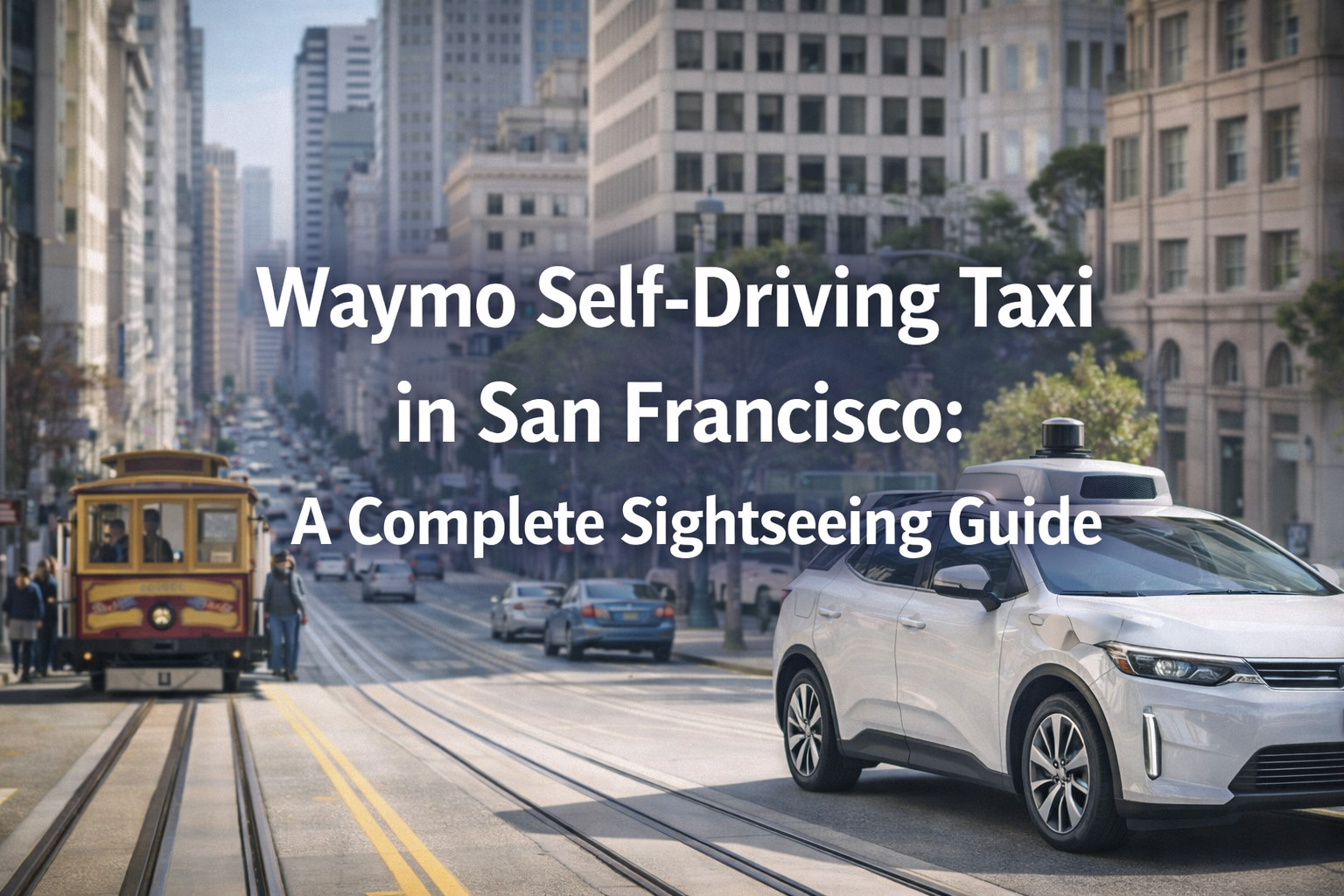
Waymo Self-Driving Taxi in San Francisco: A Complete Sightseeing Guide
Introduction
For tourists visiting San Francisco, choosing the right transportation can make or break the comfort of your trip.
Among the options, the fully autonomous self-driving taxi “Waymo” is attracting attention as a new choice.
Waymo is the culmination of technology born from Google’s self-driving project, offering a service that safely transports passengers to their destinations without a human driver.
In this guide, we thoroughly explain the capabilities and appeal of autonomous taxis based on actual Waymo riding experiences throughout various areas of San Francisco.
From sightseeing tours to driving through residential areas and responding to emergency vehicles, we provide detailed reports on how Waymo handles various situations.
This guide is packed with practical information for those planning to visit San Francisco, those interested in autonomous driving technology, and those who want to get ahead of the curve on future transportation.
🗺️ Waymo Routes Featured in This Guide
- Route 1: Alamo Square → Lombard Street (Full House filming location tour)
- Route 2: Nob Hill → Pier 33 (Alcatraz Island ferry terminal)
- Route 3: Downtown → Outer Sunset (emergency vehicle & traffic response)
- Route 4: Grandview Park → Nob Hill (residential area driving)
- Vehicle Used: Jaguar I-PACE (luxury electric SUV)
🚗 FSD Rental Car Information:
Eco Drive also offers rental cars with Tesla FSD experience available. Combine it with Waymo for an efficient San Francisco sightseeing experience.
Chapter 1: Waymo Autonomous Taxi Fundamentals
Waymo is an autonomous driving technology development company under Alphabet (Google’s parent company).
It started as Google’s self-driving project in 2009 and was spun off as an independent company in 2016.
Currently, it operates the commercial service “Waymo One” in areas including San Francisco, Los Angeles, and Phoenix.
Waymo’s biggest feature is achieving fully autonomous driving without any human driver.
There is no human driver in the vehicle, and all driving operations are performed by AI.
While Tesla’s FSD (Full Self-Driving) is classified as Level 2 autonomous driving requiring driver supervision, Waymo is classified as Level 4 autonomous driving.
Waymo’s History and Evolution
Waymo’s development spans over 15 years of history, with steady evolution throughout.
📅 History of Waymo Development
Early Period (2009-2015)
- 2009: Autonomous driving development began as a Google project. Initially used Toyota Prius
- 2014: Announced proprietary vehicle “Firefly.” An innovative design with no pedals or steering wheel
- 2015: Conducted world’s first fully autonomous driving on public roads in Austin, Texas
Independence & Commercialization Period (2016-2020)
- 2016: Spun off from Google and became independent as “Waymo”
- 2017: Began autonomous taxi pilot operations in Phoenix, Arizona
- 2018: Established partnership with Jaguar. Made the “I-PACE” autonomous. Launched paid service “Waymo One” in Phoenix in December of the same year
Expansion Period (2021-Present)
- 2021: Began service deployment in San Francisco
- 2023: Launched service in Los Angeles
- 2024: Achieved over 100,000 trips per week. Completed large-scale funding of approximately $5.6 billion
Waymo’s Technology: The Power of LiDAR Sensors
The core technology supporting Waymo’s high safety is the “LiDAR” (Light Detection and Ranging) sensor.
This sensor mounted on top of the vehicle uses laser light to accurately measure distances to surrounding objects and recognizes the environment as a 3D map.
The latest sixth-generation system is equipped with 13 cameras, 4 LiDARs, 6 radars, and more.
These sensors complement each other, enabling high-precision recognition of the surrounding environment even in adverse weather conditions like fog and rain.
It also features “External Audio Receivers (EARs)” that can detect emergency vehicle sirens in advance and respond appropriately.
Tesla FSD vs Waymo: Differences in Technical Approach
There are broadly two approaches to autonomous driving technology.
The camera-based approach adopted by Tesla and the LiDAR-based approach adopted by Waymo.
| Item | Waymo | Tesla FSD |
|---|---|---|
| Sensor Technology | LiDAR + Camera + Radar | Camera only (Vision-based) |
| Driving Level | Level 4 (Fully autonomous) | Level 2 (Driver supervision required) |
| Available Areas | Limited areas only | Can be used anywhere |
| Vehicle Ownership | Waymo owns & operates vehicles | User owns vehicle |
| Cost | Per-ride fare | Vehicle purchase + FSD option purchase |
| Network Dependency | High (Uses HD maps) | Low (Can operate offline) |
Waymo’s strength lies in the high recognition accuracy achieved by combining multiple sensors and reliable driving using detailed HD maps of specific areas.
On the other hand, Tesla FSD’s strengths are lower cost due to its simple camera-only configuration and versatility that allows it to be used anywhere.
📊 Waymo Safety Data
- Total Distance Traveled: 20 billion miles combining real-world driving and simulation (equivalent to circling the Earth about 800,000 times)
- Property Damage Accidents: 88% reduction compared to human drivers
- Personal Injury Accidents: 92% reduction compared to human drivers
- Weekly Trips: Over 100,000 (as of 2024)
Chapter 2: Full House Filming Location Tour – From Alamo Square to Lombard Street
📺 Video for This Section:
Starting from the Tanner Family House
We introduce a Full House filming location tour as a route that lets you experience the maximum appeal of sightseeing with an autonomous taxi in San Francisco—Full House being the popular 90s TV drama.
The starting point is the famous Painted Ladies near Alamo Square.
This park is where the scene of the Tanner family having a picnic was filmed in the Full House opening.
Many years have passed since it was filmed in 1987, but it still maintains its unchanged beauty today.
The Waymo Riding Experience
When you board a Waymo, relaxing music starts playing first, and a comfortable journey begins in the spacious interior.
The vehicle model used is the Jaguar I-PACE electric SUV, and I was impressed by its luxurious interior and comfortable seating.
Waymo can drive like an experienced driver.
It comes to a complete stop at stop signs and assesses the movement of surrounding vehicles at intersections before proceeding.
What was particularly impressive was seeing how Waymo understood the intention of a car trying to parallel park and waited while maintaining an appropriate distance.
Passing Through Japantown
The driving route passed through Japantown.
This is one of America’s oldest and largest Japanese communities, formed by Japanese immigrants in the early 20th century.
Particularly eye-catching is the tower called “Japantown Peace Pagoda,” which was designed by architect Yoshiro Taniguchi and donated by the City of Osaka in 1968.
Destination: Lombard Street
After climbing a steep hill, we arrived at the final destination, “Lombard Street.”
Known as “the most crooked street in the world,” this famous hill features 8 sharp hairpin turns.
These sharp curves were originally designed to safely descend the steep 27% grade (approximately 15 degrees).
🌁 Fun Fact: Golden Gate Bridge tolls are only charged when crossing the bridge toward San Francisco, approximately $9-10 (cashless only). The bridge can be windy, so bringing a jacket is recommended.
Chapter 3: To the Waterfront – From Nob Hill to Pier 33
📺 Video for This Section:
Departing from Tourist-Rich Nob Hill
For this ride, we started near Nob Hill, an area with many tourist spots, and traveled to Pier 33 (the ferry terminal for Alcatraz Island).
Waymo demonstrated movements just like an experienced human driver—driving carefully while recognizing red cones and signs at construction sites, and naturally crossing into other lanes to avoid parked cars on the street.
About Alcatraz Island
The destination, Pier 33, is the ferry terminal for Alcatraz Island, which once housed the federal prison said to be “escape-proof.”
Escape was considered difficult due to the strong tidal currents in the surrounding waters and the tight security system.
However, in 1962, there was a historic incident where prisoners dug holes through the walls using spoons and modified vacuum cleaners, then attempted to escape using homemade life jackets and a rubber raft.
🚢 Tips for Visiting Alcatraz Island
- Tickets: Advance online purchase recommended
- Ferry: Taking an early morning ferry allows you to enjoy the island at a leisurely pace
- Clothing: The prison on the island can be cold, so bring a jacket
- Audio Guide: Japanese audio guides are available
Transamerica Pyramid
The pyramid-shaped skyscraper that characterizes San Francisco’s skyline visible during the ride is the “Transamerica Pyramid.”
Completed in 1972, it is primarily used as an office building.
Known for its earthquake-resistant design, its durability was proven during the 1989 Loma Prieta earthquake.
16th Avenue Tiled Steps
A hidden gem not well known even to tourists is the 16th Avenue Tiled Steps.
These stairs are decorated with colorful mosaic art themed “From Sea to Stars” and were completed in 2005 as a neighborhood beautification project.
From the top of the stairs, you can enjoy a spectacular view overlooking San Francisco’s cityscape and the distant ocean.
Chapter 4: Emergency Vehicle & Traffic Response – Demonstrating Waymo’s Technical Prowess
📺 Video for This Section:
Response to Emergency Vehicles
One of the important indicators for measuring an autonomous vehicle’s capabilities is its response to emergency vehicles.
Waymo’s response when we heard an emergency vehicle siren approaching from behind during our ride was impressive.
In California, when an emergency vehicle approaches with its siren on, you are required to pull over to the right side as far as possible and stop. Waymo detected the siren and immediately pulled over to the right side and stopped.
We witnessed the advanced feature where the audio recognition system enables safe responses before visual recognition.
🚨 Waymo’s Emergency Vehicle Response Features
- External Audio Receivers (EARs): Detects emergency vehicle sirens in advance
- Immediate Response: Detects via audio before visual recognition, pulls over to the right and stops
- Legal Compliance: Fully compliant with California traffic regulations
Traffic Response and Lane Changes
We got caught in traffic near Golden Gate Park, but Waymo’s response was on par with human drivers.
Lane changes in traffic are particularly difficult, but it signaled at the appropriate time and safely changed lanes with cooperation from surrounding vehicles.
Also, Waymo doesn’t give the impression of “obviously being driven by a computer”—the polished, human-like smooth driving was impressive.
With no sudden braking or acceleration, it felt like being driven by an experienced, gentle driver.
San Francisco’s Fog and Autonomous Driving
One of San Francisco’s characteristic climate elements is “fog.”
It tends to occur especially on summer mornings and evenings, and locals have such affection for this fog that they’ve even given it a name: “Karl.”
Generally, fog is a factor that reduces visibility for autonomous vehicle cameras and sensors, but Waymo’s high-precision LiDAR sensors have the ability to penetrate fog particles, allowing them to accurately recognize distance and shapes even in adverse weather.
By mounting multiple types of sensors (LiDAR, cameras, radar) that complement each other’s different characteristics, it achieves safe driving in all weather conditions.
Pier 39 and Its Surroundings
Pier 39, one of San Francisco’s representative tourist attractions, is a lively wharf lined with many shops.
This bustling area for tourists is close to the Alcatraz Island ferry boarding point (Pier 33), making it an ideal base for sightseeing.
Chapter 5: Driving Performance in Residential Areas – From Grandview Park to Nob Hill
📺 Video for This Section:
Unique Driving Conditions in Residential Areas
This ride route started in a residential area in southwest San Francisco.
This area is characterized by few traffic lights, and instead features countless stop signs and street-parked cars.
Waymo demonstrated impressive driving even in these conditions.
What was particularly impressive was the smoothness of stopping and starting at stop signs.
It came to a complete stop at the appropriate position without sudden braking, confirmed the safety of the surroundings, and then gently accelerated.
The smoothness of left and right turns was also noteworthy, achieving comfortable turns without slowing down too much.
Response to Road Conditions
In sections with road bumps or “humps” (small hills for speed reduction), Waymo recognized their presence in advance and decelerated appropriately.
This maintained a comfortable ride for passengers without the vehicle rocking significantly.
The ability to recognize even subtle bumps in the ground and adjust speed is just like an experienced human driver.
In areas with high foot traffic, such as near hospitals, we also observed instances where it temporarily stopped for safety when detecting people on the sidewalk.
Waymo’s major advantage is its ability to prevent accidents caused by inattention due to fatigue or stress, which is common among human drivers.
Grandview Park
Grandview Park, our starting point, is a spot where you can enjoy spectacular views, as its name suggests.
From the summit, you can overlook Golden Gate Bridge and Golden Gate Park.
The view is especially magnificent on clear days, making it an ideal place to get a sense of the entire city.
Golden Gate Park and The Panhandle
Golden Gate Park, which we passed through on our route, is a park boasting a vast area of approximately 4.1 square kilometers (about 1.6 square miles)—about 8.8 times the size of Tokyo Disneyland.
The adjacent Panhandle is a long, narrow park named for its shape resembling a frying pan’s handle, and serves as a relaxation spot for locals.
🌳 Fun Fact: Golden Gate Park’s area is approximately 1,017 acres (about 4.1 square kilometers), which is about 8.8 times larger than Tokyo Disneyland (approximately 0.465 square kilometers)! The vast grounds include art museums, a Japanese garden, botanical gardens, and more.
Chapter 6: Waymo’s Latest Developments and Future Outlook
Tokyo Expansion Plans
One of the most noteworthy pieces of news is Waymo’s Tokyo expansion plans.
In December 2024, Waymo, Japan Taxi (Nihon Kotsu), and the taxi app GO announced a partnership to accelerate the introduction of autonomous taxis in Tokyo.
The initial phase is planned to begin in central Tokyo in 2025, where Nihon Kotsu drivers will first manually drive Waymo vehicles to conduct tests for introducing autonomous driving technology to Tokyo’s public roads.
🇯🇵 Details of Waymo’s Tokyo Expansion
- Start Date: Testing scheduled to begin in early 2025
- Target Areas: Minato Ward, Shinjuku Ward, Shibuya Ward, Chiyoda Ward, Chuo Ward, Shinagawa Ward, Koto Ward
- Vehicles Used: Jaguar I-PACE (same vehicles as in San Francisco)
- Initial Phase: Nihon Kotsu drivers will manually drive to collect data
- Purpose: Adaptation to Tokyo’s unique environment including left-hand traffic, narrow roads, and complex intersections
According to Nihon Kotsu, autonomous driving is being introduced to address social issues such as improving regional transportation in the face of population decline and labor shortages.
This could help solve Tokyo’s taxi driver shortage problem.
Expanded Partnership with Uber
The partnership between Uber and Waymo is also expanding, and in Phoenix, Austin, and Atlanta, you can call a Waymo through the Uber app.
Through this partnership, the division of roles has become clear: Uber provides vehicle management services while Waymo handles autonomous driving system operation and passenger support.
Strategic Partnership with Hyundai
In October 2024, a multi-year strategic partnership with Hyundai Motor Company was announced.
The plan is to integrate Waymo’s sixth-generation autonomous driving technology “Waymo Driver” into Hyundai’s electric vehicle “IONIQ 5.”
The IONIQ 5, which is popular in California, is scheduled to begin public road testing in late 2025 and will be operated as a vehicle for Waymo’s autonomous taxi service “Waymo One” within a few years.
Technological Innovation: EMMA
Waymo continues to develop technology with the goal of becoming “the world’s most trusted driver.”
At the end of October 2024, an announcement was made about the latest research model “EMMA” (End-to-End Multimodal Model for Autonomous Driving).
This is an AI model specialized for autonomous driving that utilizes “Gemini” technology developed by Google DeepMind.
EMMA’s feature is its ability to learn multiple tasks simultaneously and demonstrate excellent performance in areas such as driving route planning, 3D object detection, and understanding of surrounding situations.
It also has the flexibility to appropriately handle objects that weren’t pre-trained (such as dogs).
Waymo Via (Logistics Service)
Waymo is not only for passengers but also operates “Waymo Via,” a commercial freight transportation service.
By mounting Waymo’s autonomous driving system on large trucks (semi-trucks), it aims to improve efficiency and safety in long-distance transportation.
Testing and operations are conducted in regions where logistics are concentrated, such as Texas, Arizona, and California, with many expected benefits including reduced accidents from human error, 24/7 operation, and reduced cargo impact through stable driving.
Expansion to Miami
In addition to Tokyo, expansion to Miami has also been announced.
In early 2025, the same Jaguar I-PACE vehicles currently in use will begin operating in Miami, and by around 2026, general users will be able to use them through the Waymo app.
Driving tests in Miami’s harsh rainy conditions have reportedly contributed to further improving Waymo’s autonomous driving capabilities.
Chapter 7: Waymo Usage Guide
How to Use the App
Using Waymo is very simple.
Just download and register for the Waymo app, and you can start using it right away.
Previously there was a waitlist, but now you can use it immediately after registration.
📱 How to Use Waymo
- Step 1: Download and register for the Waymo app
- Step 2: Enter pickup location and destination
- Step 3: Request a ride
- Step 4: Board the Waymo at the designated location
- Step 5: Payment is automatically completed upon arrival at destination
Benefits of Using Waymo
The biggest benefit of using Waymo for San Francisco sightseeing is its high safety and comfort.
The interior is spacious and comfortable, with relaxing music playing.
Especially in hilly San Francisco, the ability to reduce the burden of walking is also a major attraction.
✅ Benefits of Using Waymo
- No Hassle Finding Parking: Easily visit popular tourist spots like Lombard Street and Pier 33 that don’t have dedicated parking
- Smartphone Convenience: Everything from calling to payment is completed on the app, eliminating the need to carry cash or cards
- More Flexible Than Public Transportation: Direct access to places far from bus stops or metro stations
- Safe and Comfortable Ride: Travel with peace of mind even in hilly San Francisco
- No Language Barrier: No communication with drivers needed, so those who aren’t confident in English can relax
Notes and Limitations
⚠️ Things to Note When Using Waymo
- Service Area Restrictions: Currently only available in certain areas within San Francisco. Cannot cross the Golden Gate Bridge
- Wait Times During Busy Periods: Arrival may be delayed on days or times with many tourists
- Passenger Limit: Maximum 4 passengers
- Large Luggage Restrictions: May not be able to accommodate large suitcases and similar items
Bonus: San Francisco Tourist Spot Guide
Here’s a summary of San Francisco tourist spots you can visit by Waymo.
Classic Spots
🌉 Golden Gate Bridge
- San Francisco’s representative landmark
- Can be crossed by car, on foot, or by bicycle
- Toll: Approximately $9-10 only when crossing toward San Francisco (cashless only)
- Note: Waymo currently cannot cross the bridge
🏝️ Alcatraz Island
- Former federal prison, now a national park
- About 15 minutes by ferry from Pier 33
- Advance online ticket purchase recommended
- Japanese audio guide available
🛍️ Pier 39
- Tourist area with shops, restaurants, and a Ferris wheel
- You can see colonies of sea lions
- Offers views of both Golden Gate Bridge and Alcatraz Island
Full House Filming Locations
🏠 Alamo Square / Painted Ladies
- The park where the family had a picnic in the Full House opening
- Famous for the colorful Victorian houses known as “Painted Ladies”
- Located on a hill with panoramic views of the surrounding area
🛤️ Lombard Street
- Famous as “the most crooked street in the world”
- Features 8 sharp hairpin turns
- Sidewalks and stairs on both sides of the road allow you to enjoy it on foot as well
Hidden Gems
🌄 Grandview Park
- Views of the Golden Gate Bridge from the summit
- Few tourists, so you can enjoy it at a leisurely pace
- Requires climbing a long staircase
🎨 16th Avenue Tiled Steps
- Colorful mosaic art themed “From Sea to Stars”
- Completed in 2005 as a neighborhood beautification project
- Less crowded, allowing for a relaxed stroll
⛵ Sausalito
- Beautiful harbor town north of San Francisco
- Experience an old-fashioned atmosphere
- Also accessible by ferry
Conclusion: Experiencing the Future of Transportation in San Francisco
Through riding experiences on four routes, I felt that Waymo autonomous taxis have matured to a practical level of technology.
Technical Achievements
Waymo demonstrated excellent driving performance in various road environments, from complex urban traffic to narrow residential streets.
The natural quality was impressive—rapid response to emergency vehicles, smooth lane changes in traffic, and attentive responses to road conditions—as if an experienced human driver were at the wheel.
Over 15 years of research and development and the accumulation of massive driving data totaling 20 billion miles (equivalent to circling the Earth about 800,000 times) support this high level of completion.
Convenience for Sightseeing
For San Francisco sightseeing, Waymo is an extremely convenient means of transportation.
No hassle finding parking, and everything from calling to payment is completed with just a smartphone.
Even in hilly San Francisco, you can comfortably tour the tourist spots.
Also, since no communication with drivers is needed, those who aren’t confident in their English can use it with peace of mind—another major benefit.
Expectations for the Future
With the Tokyo expansion, partnership with Hyundai, and development of the new AI model “EMMA,” Waymo is expected to continue evolving and expanding in the future.
Testing is scheduled to begin in Japan from 2025, and the day when you can ride a Waymo in Tokyo may come in the near future.
⚠️ Important Notes: While Waymo is equipped with advanced autonomous driving technology, service areas are limited. When planning sightseeing in San Francisco, we recommend checking the available areas in the Waymo app in advance. Also, service content may change without notice.
Our Services
We offer comprehensive automotive solutions—buy, sell, rent, and repair in one place.

Car Sales
Browse our lineup of quality used cars with transparent pricing and up to a two-year warranty on select models.
View Inventory
Auto Repair
Get expert service from our certified Toyota Master Mechanic. We primarily service Toyota vehicles.
Schedule Service
Trade-in / Sell
We pay top dollar for your vehicle—especially hybrids. Count on fair, transparent appraisals.
Get Estimate
Car Rentals
Choose between fuel-saving hybrid rentals and a Tesla with Full Self-Driving Capability—both at competitive rates.
Reserve NowYou May Also Like