Hydrogen Cars vs EVs: What I Learned Driving Both as a Daily Car
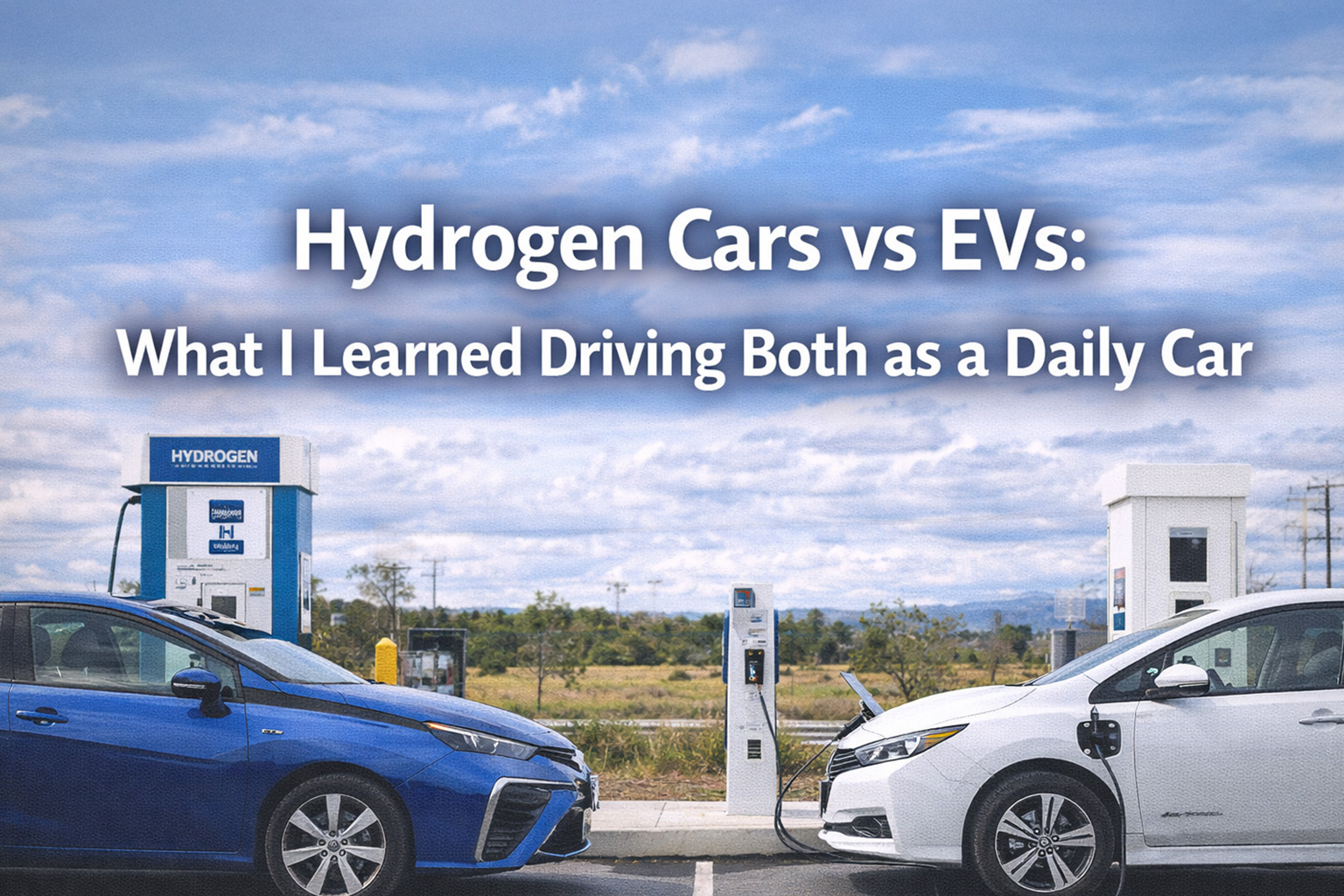
Hello everyone. This is Suzuki from EcoDrive.
Today’s topic is “Comparing Hydrogen Cars and Electric Vehicles” from a consumer perspective.
Since I have experience driving a hydrogen car for a while, I think I can share some useful insights from a consumer’s point of view.
【Video Version Available Here】
Analysis Based on Real Experience

The reason I can speak about this topic from a consumer perspective is that I’ve driven 4 electric vehicles and also the hydrogen-powered MIRAI.
The first one I drove was the Nissan Leaf.
This was really a challenging car.
It could only go 80 miles (about 120 km) on a full charge, the battery drained quickly, and using the air conditioning consumed power even more rapidly—it was completely unusable as daily transportation.
My Journey with Electric Vehicles and Their Evolution
After that, I switched to a Tesla Model S.
This was an excellent vehicle—even back then it could go about 180–200 miles, which completely changed my perspective on electric cars.
I sold that Model S and switched to a newer one that could go 250 miles (about 400 km).
This was truly a wonderful car—absolutely no problems for daily life.
After that, I tried the hydrogen-powered MIRAI, but this was also a challenging car.
There were very few hydrogen filling stations, making it extremely inconvenient.
Currently, I drive a Tesla Model 3.
It’s Tesla’s compact model, but it can go 250 miles (about 400 km).
Reason 1: Inconvenience of Refueling
The first reason is that having to go somewhere specifically to fill up with hydrogen is a hassle.
In my case, since I started with electric vehicles, switching from an EV to the MIRAI felt very inconvenient.
You have to make a special trip just to fill up with hydrogen.
This is fundamentally inconvenient. Think about your smartphone—you probably charge it at home most of the time.
You charge it at home, at work, and so on.
What would you think if you had to go to a specific location to charge it?
Even if it were a high-performance smartphone, would you buy one if you couldn’t charge it at home or work and had to go to a specific location instead?
You probably wouldn’t buy such a smartphone.
The Reality of Electric Vehicle Charging

By the way, I don’t actually charge my Tesla at home.
I have a garage at home, but my wife’s car is really big, and our kids’ toys and bicycles are scattered everywhere, so there’s no space for my car—that’s the main reason I use street parking.
So I don’t charge at home, but I can charge at work, and I also charge at cafés I frequently visit.
There are also charging stations at shopping centers, so I charge while working at a café or while shopping.
The charging speed is surprisingly fast, and it doesn’t interfere with my daily life at all.
If I urgently need to charge, I sometimes go to a Tesla Supercharger.
Charging for about 20 minutes, or at most 30 minutes, gets me close to a full battery, so there’s no problem at all.
Practical Challenges of Hydrogen Refueling
People often say “electric vehicles take a long time to charge,” but actually, hydrogen refueling also takes time.
When I was using it, there were very few hydrogen stations compared to gas stations—sometimes not even one per city.
There’s a hydrogen station about 20 minutes by car from where we live, but the lines are quite long.
You have to wait in line for 15 to 20 minutes just to fill up with hydrogen.
When you factor in travel time to get there, waiting time, and the actual filling time, it takes quite a while.
In comparison, with an electric vehicle, you can charge at places you normally visit—cafés, shopping centers, work—so you’re not losing any extra time.
In that sense, I actually think electric vehicles are more convenient.
Comparison with Gasoline Cars
Since I started with electric vehicles, I really understand the feeling that “going out of your way to fill up is a hassle” with hydrogen cars.
If you drive a gasoline car, you might think “it’s not that big of a deal,” but no, it really is a hassle.
The great thing about gasoline cars is that there are gas stations everywhere.
Even when you exit the highway, there’s usually a gas station right there—they’re truly everywhere.
But hydrogen stations are different—they’re extremely rare.
Infrastructure Development Challenges
Apparently, it costs hundreds of millions of yen to build a single hydrogen station, which is one reason why adoption isn’t progressing quickly.
On the other hand, electric vehicle batteries are improving rapidly.
The Nissan Leaf I drove 6–7 years ago could only go 80 miles, but the latest electric vehicles can go 500 miles (about 800 km).
That’s equal to or greater than a typical gasoline car’s range—more than sufficient performance.
With this kind of range, you need to charge much less frequently.
New Technology Developments

Furthermore, Isuzu recently announced a very interesting concept—a battery-swapping EV truck.
Battery stations charge batteries overnight, and when a truck needs a swap, they simply exchange it for a pre-charged battery.
This takes almost no time at all.
This time-saving design of swapping pre-charged batteries is very efficient and practical.
If this trend spreads across manufacturers in the future, we could see an increase in battery-swapping stations.
Introducing battery-swapping stations seems more realistic than deploying hydrogen stations.
Reason 2: The Frunk Problem
The second reason is the lack of a frunk (front trunk).
A frunk is short for front trunk—the area under the hood where the engine is normally housed in gasoline cars.
In electric vehicles, there’s nothing in this space, so it can be used as storage space like a trunk.
While it’s not as large as the rear trunk, it’s surprisingly convenient.
On the other hand, hydrogen cars cannot have a frunk.
This is because generators and other machinery are packed into the front section—just like conventional gasoline engine cars, it’s filled with mechanical components, making it impossible to use as a front trunk.
Reason 3: The High Price Problem
EVs are said to have lower barriers to entry compared to gasoline cars.
While gasoline cars are said to have 40,000 to 50,000 parts, electric vehicles have only 10,000 to 20,000 parts.
On the other hand, hydrogen cars are said to have even more parts than gasoline cars.
This means when manufacturers invest in hydrogen vehicles, the entry costs are higher due to the greater number of parts, resulting in fewer companies entering the market.
This inevitably keeps retail prices high.
High prices aren’t good for consumers’ wallets, and the likelihood of people choosing to pay more for a hydrogen car is significantly reduced.
Future Potential of the Electric Vehicle Market

In contrast, new companies are entering the electric vehicle market every year.
This is because the barrier to entry is lower due to fewer parts.
The more competition increases, the more prices will decrease.
Furthermore, as batteries continue to improve and cheaper ones become widespread, electric vehicle manufacturing costs will decrease, which should lead to lower prices.
As things stand now, hydrogen vehicles will need to solve these kinds of problems in order to grow their market share.
Our Services
We offer comprehensive automotive solutions—buy, sell, rent, and repair in one place.

Car Sales
Browse our lineup of quality used cars with transparent pricing and up to a two-year warranty on select models.
View Inventory
Auto Repair
Get expert service from our certified Toyota Master Mechanic. We primarily service Toyota vehicles.
Schedule Service
Trade-in / Sell
We pay top dollar for your vehicle—especially hybrids. Count on fair, transparent appraisals.
Get Estimate
Car Rentals
Choose between fuel-saving hybrid rentals and a Tesla with Full Self-Driving Capability—both at competitive rates.
Reserve NowYou May Also Like