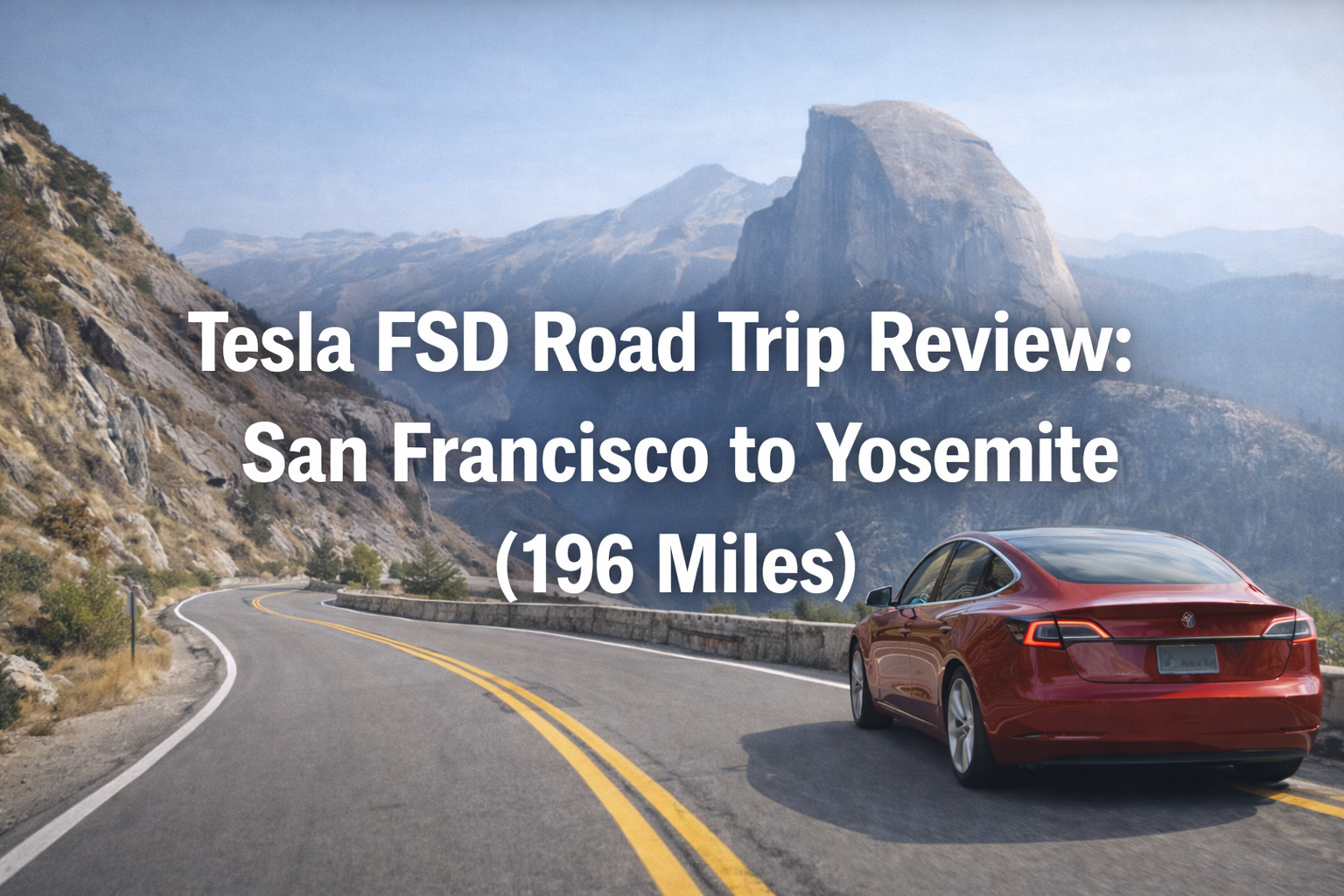
Tesla FSD Road Trip Review: San Francisco to Yosemite (196 Miles)
Introduction
Tesla’s FSD (Full Self-Driving) is attracting worldwide attention as a system at the cutting edge of autonomous driving technology.
But how well does it actually perform on long-distance drives?
In this guide, we’ll provide a thorough breakdown of where autonomous driving technology stands today, based on our real-world experience driving approximately 315 kilometers (196 miles) from downtown San Francisco to Yosemite National Park using Tesla FSD.
We’ll give you a detailed report on how FSD handles California’s diverse road environments—from complex urban traffic to high-speed freeway driving, monotonous agricultural roads, and winding mountain passes.
Whether you’re curious about trying Tesla FSD, interested in autonomous driving technology, or planning a California road trip, this guide is packed with practical information for you.
🗺️ Complete Route Information
- Total Distance: Approximately 315 kilometers (196 miles)
- Travel Time: Approximately 4 hours 30 minutes
- Starting Point: Downtown San Francisco
- Destination: Yosemite National Park
- Major Waypoints: Bay Bridge, Oakland, Tracy, Modesto, Turlock, Merced, Mariposa
- FSD Version: 12.5
Chapter 1: Tesla FSD Basics
Tesla FSD (Full Self-Driving) is an advanced driver assistance system developed by Tesla.
While the name includes “Full Self-Driving,” it is currently classified as a Level 2 autonomous driving system that requires driver supervision.
This means the system handles steering, acceleration, and braking automatically, but drivers must always pay attention to the road and be ready to take over manual control immediately if needed.
FSD’s key feature is its ability to handle a wide range of scenarios—from recognizing traffic signals and making turns in urban areas, to lane changes and long-distance cruising on freeways.
While traditional Autopilot was primarily designed for freeway use, FSD also assists with driving in more complex urban environments.
Key Improvements in FSD Version 12.5
For this long-distance test, we used FSD version 12.5.
This version includes significant improvements compared to earlier versions.
※You can experience the latest version of Tesla FSD through our “FSD Rental Car” service.
The version may vary depending on the timing, so please feel free to contact us.
The biggest change is the driver monitoring method.
In previous versions (12.4.2 and earlier), you needed to grip the steering wheel or apply pressure periodically, but starting with 12.5, the system only uses the cabin camera to check the driver’s gaze, eliminating the need to constantly hold the steering wheel.
This allows for a more comfortable drive without arm fatigue.
📱 Key Improvements in FSD Version 12.5
- Switch to Gaze-Based Monitoring: No longer required to grip the steering wheel
- Unified City and Highway Systems: Integrated system for more consistent driving
- Improved Object Recognition: Better identification accuracy for pedestrians, motorcycles, and construction cones
- Reduced Phantom Braking: Significant decrease in unnecessary sudden braking
- End-to-End Approach: AI handles everything from video data analysis to decision-making and vehicle control
Tesla FSD vs Waymo: Different Technical Approaches
There are two main approaches to autonomous driving technology.
Tesla uses a camera-based approach, while Waymo uses a LiDAR-based approach.
Tesla’s approach is based on the same philosophy as how humans drive using their eyes and brain.
Eight cameras mounted on the vehicle cover 360 degrees around the car and can detect objects up to approximately 250 meters ahead.
Elon Musk has called LiDAR a “crutch,” claiming that a properly trained AI combined with cameras can achieve driving performance equal to or better than humans.
| Category | Tesla FSD | Waymo |
|---|---|---|
| Sensor Technology | Cameras only (vision-based) | LiDAR + Cameras + Radar |
| Available Areas | Usable anywhere | Limited areas only |
| Driving Level | Level 2 (driver supervision required) | Level 4 (fully driverless) |
| Cost | Relatively affordable | Expensive (due to LiDAR) |
| Network Dependency | Low (can operate offline) | High |
A major advantage of Tesla FSD is that it doesn’t depend on an internet connection.
Since it can operate using GPS and camera sensors, it functions even in areas like Yosemite National Park where there are no streetlights, it’s completely dark at night, and internet connectivity is limited.
🔗 Related Article: If you’re interested in Waymo, check out the article below.
Waymo Robotaxi Review: Emergency Vehicle & Traffic Handling
Chapter 2: FSD Performance in Urban Areas – San Francisco Streets
📺 Video for This Section:
🔗 Detailed Article:
Tesla FSD Urban Driving in San Francisco: Hands-On Review
Handling Complex Urban Environments
San Francisco is one of the most challenging environments for Tesla FSD.
In this urban setting with steep hills, streetcars, bike lanes, pedestrians, and complex intersections, FSD operated surprisingly smoothly.
The starting point near the border of the Nob Hill and Pacific Heights neighborhoods is one of San Francisco’s safer areas, with many hotels and historic buildings.
FSD showed stable performance even on the steep hills characteristic of this area. Smooth acceleration on uphill starts, appropriate deceleration on downhill sections, and stable steering through curves were all at a level comparable to a human driver.
Traffic Signal and Sign Recognition Accuracy
One of the most important features when using FSD in urban areas is traffic signal and sign recognition.
At San Francisco’s complex intersections, multiple signals may point in different directions, making it difficult to determine which signal to follow.
In most cases, FSD accurately recognized the relevant signal and stopped and started appropriately.
Stopping at red lights, deciding to slow down for yellow lights, and timing for starting on green lights were all at a level equal to or better than what a human driver would do.
Chapter 3: Long-Distance Freeway Performance
📺 Video for This Section:
🔗 Detailed Article:
Tesla FSD vs Waymo: Hidden San Francisco Views & Yosemite Drive
Bay Bridge Driving Experience
An important bridge to cross on the way from San Francisco to Yosemite is the Bay Bridge (San Francisco–Oakland Bay Bridge).
This approximately 7.2-kilometer bridge connects San Francisco and Oakland, with daily traffic reaching about 270,000 vehicles.
The Bay Bridge has a double-deck structure, with the upper deck heading to San Francisco and the lower deck heading to Oakland.
There’s a tunnel through Yerba Buena Island partway across, and the bridge structure changes midway. FSD handled the complex lane configurations on the bridge and the lighting changes through the tunnel appropriately.
| Category | Bay Bridge | Golden Gate Bridge |
|---|---|---|
| Total Length | Approximately 7,180 meters | Approximately 2,737 meters |
| Opened | 1936 | 1937 |
| Daily Traffic | Approximately 270,000 vehicles | Approximately 100,000 vehicles |
| Features | Commuter/freight focus, vehicles only | Tourist destination, pedestrians and bicycles allowed |
Two Patterns for Lane Changes
When FSD is ON, lane changes are executed in two patterns:
- Automatic Lane Changes: FSD assesses the situation and automatically changes lanes. When there’s a slower vehicle ahead or you’re approaching an exit, the system executes the lane change at the optimal timing.
- Driver-Initiated Lane Changes: After the driver activates the turn signal, FSD executes at the appropriate timing. It accurately measures distances to surrounding vehicles and only changes lanes when safety is confirmed.
Lane changes on freeways are frequently needed during long-distance drives.
With FSD using multiple cameras to cover blind spots and determining optimal timing, both driver fatigue and accident risk are reduced.
Highway Stability
During driving on I-580 freeway, we fully experienced FSD’s stability.
While cruising at 65-75 mph (approximately 105-120 km/h), it accurately maintained the center of the lane and kept appropriate following distance from vehicles ahead.
The response when vehicles ahead brake is also excellent.
When FSD recognizes brake lights on the vehicle ahead, it immediately begins decelerating, maintaining a safe following distance while avoiding hard braking.
This response is faster and more consistent than a human driver.
Chapter 4: Central Valley – Driving Through California’s “Breadbasket”
📺 Video for This Section:
🔗 Detailed Article:
SF to Yosemite Drive with Tesla FSD: Central Valley
FSD Performance on Country Roads
On Central Valley’s straight roads, FSD showed very stable driving.
Even as the monotonous scenery continued, it accurately maintained the center of the lane and kept appropriate following distance from vehicles ahead.
On long-distance drives, driving on monotonous roads like these causes the most fatigue.
By leaving the driving to FSD, the driver has the freedom to enjoy the surrounding scenery or take a rest.
Why Nut Farming Thrives in Central Valley
There are five important factors why the Modesto and Turlock areas have become the world’s largest nut-producing region.
1. Ideal Mediterranean Climate: The dry heat of summer and mild cold of winter provide optimal conditions for almond and walnut flowering and fruiting.
2. Fertile Soil: Nutrient-rich, well-draining soil created by river and lake sediments from millions of years ago provides ideal growing conditions for nut trees.
3. Abundant Water Resources: Irrigation systems from major rivers like the Sacramento and San Joaquin are well developed.
4. Economic Infrastructure: Nut processing facilities and export infrastructure are well established.
5. Advanced Agricultural Technology: California research institutions continue developing improved varieties and cultivation techniques.
⚠️ Note for Central Valley Travel
This region is very dry and quite different from Japan’s humid environment.
Dehydration can sneak up on you without realizing it, so we recommend bringing plenty of water and purchasing at a supermarket beforehand to keep in the car. (There are almost no vending machines or convenience stores.)
Chapter 5: Technical Challenges and Limitations of FSD
📺 Video for This Section:
🔗 Detailed Article:
Evaluating the Limits and Challenges of Self-Driving: Crossing California with Tesla FSD
⚠️ Important: Please note that the issues described in this section may be resolved through ongoing updates.
Unstable Behavior Near Large Trucks
During this drive, we also observed some challenges with FSD.
These are important examples for understanding the current limitations of autonomous driving technology.
Unexpected behavior was observed when operating near large trucks.
When attempting to pass a large truck in the right lane, there were cases where the system tried to change into the right lane (toward the truck) despite recognizing a vehicle approaching from the left rear.
🚛 Details of Observed Situation
- Step 1: Attempting to pass a large truck in the right lane
- Step 2: Recognizes vehicle approaching from left rear, displayed in blue
- Step 3: Unexpectedly attempts lane change to right lane (toward truck)
- Step 4: Warning displayed due to truck speed increase, FSD disengaged
Lane Merge Decision Challenges
Challenges with complex situation judgment were also seen during lane merges.
When recognizing that the right lane would end due to a merge and attempting to change to the left lane, warnings appeared due to a vehicle approaching from the left rear.
In this situation, since FSD had recognized the merge in advance, it would have been ideal to move to the far-left lane earlier, slow down to match the merging truck, or make an earlier lane change decision.
※This phenomenon was not observed in V13, suggesting it may have been updated.
Temporary Navigation Confusion
Even when set to continue straight on the freeway, FSD was observed momentarily heading toward a different exit.
This behavior is similar to a “mistake” that humans can also make, and in a sense could be called a human-like judgment error.
Taking the wrong exit can result in significant time loss getting back on the freeway.
In such situations, quick disengagement of FSD is important.
NHTSA Investigation and Safety Concerns
🚨 Important Safety Information: In 2024, the National Highway Traffic Safety Administration (NHTSA) launched an investigation covering approximately 2.4 million Tesla vehicles.
FSD-related accidents have occurred in conditions with poor visibility such as bright sunlight, fog, and dust, including one fatal accident.
This investigation evaluates how FSD can properly detect and respond to poor visibility conditions.
As a fundamental challenge of camera-based systems, it highlights that, like humans, there are limits to judgment capability in bad weather and poor visibility conditions.
FSD Advantages and Situations Requiring Caution
✅ FSD Advantages
- Fatigue reduction on long-distance drives
- Improved safety through blind spot coverage
- Stable driving through consistent decision-making
- 360-degree monitoring with multiple cameras
⚠️ Situations Requiring Caution
- Driving near large trucks
- Complex lane merge points
- Poor visibility (fog, bright sunlight)
- Situations with overlapping decisions
New Arrivals
Discover our newest arrivals—available now!
Chapter 6: FSD in Mountain Terrain – The Final Challenge to Yosemite
📺 Video for This Section:
🔗 Detailed Article:
Tesla FSD Yosemite Road Trip: CA‑140 Mountain Driving
CA-140: Dramatic Change from Flatlands to Mountains
CA-140, the setting for the final stage, is a 103-mile (166 km) route starting from Merced, passing through Mariposa, and continuing to Yosemite National Park’s Arch Rock Entrance.
It’s one of California’s most dynamic driving routes, with scenery changing dramatically from flat agricultural land to mountain terrain.
🛣️ CA-140 Features
- Starting Point: Merced (agricultural area)
- Midpoint: Mariposa (small town, population approximately 1,200)
- Endpoint: Yosemite National Park Arch Rock Entrance
- Total Length: 103 miles (166 km)
- Travel Time: 45 minutes to 1 hour from Mariposa to Yosemite
- Scenery: Changes from pastures → rolling hills → mountain terrain
Challenges with Curves on Mountain Roads
Several technical challenges were observed during mountain driving.
Curve Instability: On sharp curves, there was a tendency to swing too wide, nearly crossing into the oncoming lane.
This requires particular attention on roads near cliffs.
Speed Adjustment Issues: Speed drops dramatically on sharp curves, potentially holding up following vehicles on mountain roads without passing lanes.
Gaze Detection Sensitivity: When looking toward the inside of a curve, a “Please look ahead” warning would sometimes appear, showing slight friction with natural human driving behavior.
Network Connection Challenges and Solutions
In the mountain areas around Yosemite, there are many zones where cell phone signals don’t reach.
Since FSD basically operates using GPS and camera sensors, it can drive without a network connection, but the following points require attention:
📶 Navigation Notes for Mountain Areas
- Pre-Setup: Set your destination while you have network connectivity
- Route Change Risk: If FSD selects a different route, it cannot re-search
- Getting Lost Risk: Getting lost on mountain roads with few signs could lead to running out of charge
- Countermeasures: Download maps in advance and ensure sufficient charge
Chapter 6.5: Driving in the Park After Arriving at Yosemite
After completing the 315-kilometer journey from San Francisco, we finally arrived at Yosemite National Park.
But this is where the real adventure begins.
We’ll show you the Tesla FSD experience inside the park, scenic spots like El Capitan and Yosemite Falls, and encounters with wildlife through three videos.
🔗 Detailed Article:
Yosemite National Park Scenic Drive Guide with Tesla FSD
Video 1: From Departure to Park Entrance
We’ll show you the journey from leaving Yosemite View Lodge to passing through Yosemite National Park’s Arch Rock Entrance.
Passing under the massive natural arch-shaped rock is a moving experience that perfectly marks the beginning of your Yosemite adventure.
🎫 Entry Tips
- Entrance Fee: $35 per vehicle (valid for 3-7 days with receipt)
- Advance Reservations: Required depending on the season
- Essential Item: Since internet connectivity is unreliable inside the park, be sure to keep the paper map you receive at the entrance
Video 2: El Capitan Route and Historical Exploration
While driving the scenic route with views of El Capitan, we’ll introduce Yosemite’s wildlife and the history of the Miwok indigenous people.
El Capitan, at approximately 7,573 feet elevation, is a dream destination for climbers worldwide—a massive granite monolith formed about 100 million years ago.
🐻 Bear Safety Is Essential
Yosemite has strict rules regarding bear protection, and violations can result in fines up to $5,000.
Don’t leave food on balcony tables, avoid eating inside tents, and properly store all food items.
Video 3: Relaxed Drive & Sightseeing Guide
While heading to the Yosemite Falls parking lot, we’ll share park dining information and recommended spots.
We’ll cover Yosemite Falls (North America’s tallest waterfall with a total drop of approximately 739 meters), the Starbucks with an incredible view, and trail information for everyone from beginners to advanced hikers.
Chapter 7: Practical Guide for Long-Distance EV Travel
Using the Supercharger Network
Battery range is a concern on long-distance drives, but Tesla’s navigation system automatically suggests Supercharger stops along the way.
By basically following the suggested route, you can reach your destination without any problems.
🔋 Supercharger Charging Time Estimates
- 0→50% charge: Approximately 10-15 minutes
- 0→80% charge: Approximately 25-30 minutes
- Full charge (100%): Approximately 40-50 minutes
- Recommended Charge Level: Usually up to 80% (to protect battery life)
Tesla Supercharger payments are automated, so no cash or card handling is required.
Simply park, connect the charging cable, charging begins, and fees are automatically billed to your account.
Tesla Model 3 Range
🔋 Tesla Model 3 Range
- Early Models (2017-2018): Approximately 354-386 km (220-240 miles)
- Newer Long Range (2019 onwards): Up to 576 km (358 miles)
- Note: Range decreases with high-speed driving and repeated rapid acceleration
Charging Environment at Yosemite
🔋 Charging Environment at Yosemite National Park
Supercharger (Yosemite View Lodge)
- 0→50% charge: Approximately 10-15 minutes
- 0→80% charge: Approximately 25-30 minutes
- Location: Hotel facility outside the park
Note About Glacier Point, Etc.
There are no chargers at the summit, so it’s important to fully charge at lower elevations before heading up.
However, on the way back down, regenerative braking may mean almost no battery loss.
Luggage Storage and Using the Frunk
One of Tesla’s convenient features is that because there’s no engine, there’s also storage space in the front (frunk).
The Model 3 has an 88-liter frunk and a 594-liter rear trunk—impressive capacity.
🧳 Luggage Storage Tips: Two large 80+ liter suitcases won’t fit, but one large suitcase plus two carry-on sized bags is doable. There’s also additional storage space under the trunk floor.
Chapter 8: Practical Guide for Safe FSD Use
Be Ready to React Immediately
The most important thing is to always be prepared to immediately switch to manual driving if any issue occurs with FSD.
You don’t need to keep your hands on the wheel, but we recommend keeping your hands in a position where you can quickly grab it when needed.
🛡️ Practical Advice for Safe Driving
- Be Ready to React Immediately: Always be prepared to switch to manual driving if any issue occurs with FSD
- Situation-Based Judgment: Since the goal is comfortable driving, don’t hesitate to disengage FSD if you feel uneasy
- Continuous Observation: Carefully observe FSD behavior, especially around large vehicles and during navigation decisions
Situation-Based FSD Usage Decisions
The purpose of using FSD is comfortable driving, and it’s important to disengage FSD without hesitation if you feel uneasy.
Consider disengaging FSD in situations like these:
- When large vehicles are nearby (especially when passing trucks or during merges) and behavior is unstable
- Sections with consecutive complex splits or merges
- Construction zones or areas with unclear lane markings
- Bad weather conditions (heavy rain, thick fog, bright sunlight)
Bonus 1: Yosemite National Park Guide
Registered as a UNESCO World Heritage Site in 1984, Yosemite National Park is a natural treasure known for its massive granite cliffs, lush forests, and crystal-clear rivers and waterfalls.
Glacier Point: Yosemite’s Highlight
From Glacier Point, Yosemite’s most famous viewpoint, you can enjoy stunning views of the iconic Half Dome directly ahead.
It offers the best scenery of any car-accessible viewpoint and is the highlight of Yosemite sightseeing.
🏔️ Fun Fact: The three lines in outdoor brand “The North Face’s” logo actually represent the north face of Half Dome. If you’re a North Face fan, be sure to gaze at Half Dome with that extra bit of appreciation!
Giant Sequoia: Living Witnesses from Ancient Times
One of Yosemite’s highlights is the Giant Sequoias, which live for 1,000 to 3,000 years, with some reaching up to 4,000 years old.
With base diameters of 5-9 meters and trunk circumferences of 15-30 meters, their immense size makes the surrounding trees look thin in comparison.
🌲 Amazing Features of Giant Sequoias
- Age: 1,000-4,000 years
- Bark Thickness: Over approximately 30 cm
- Secret to Longevity: Thick bark protects against pests, disease, and fire
- Tannin Content: Natural defense system that prevents invasion by pests and fungi
Living with Wildlife
Yosemite is home to diverse wildlife including bears, deer, and coyotes, with activity particularly high during morning and evening hours.
As the “Speeding Kills Bears” signs indicate, obeying speed limits is important for protecting wildlife. In this regard, FSD’s consistent speed management also contributes to wildlife protection.
🐻 Wildlife Observation and Safety Measures
- Best Viewing Times: Morning and evening hours are optimal
- Food Management: Proper food storage is essential for bear safety
- Trash Management: Be careful not to attract wildlife
- Speed Limits: Prevent collision accidents with animals
- Seasonal Closures: Roads may close in winter due to snow
Practical Sightseeing Advice
🌅 Importance of Timing: Weather changes quickly at Yosemite—it may be sunny in the morning but cloudy by afternoon. Starting early helps you make the most of your sightseeing time.
👟 Gear Preparation: Some trails are slippery with rocks and sand, so hiking boots are recommended. Also, since water stations are limited, bring plenty of water.
🧢 UV Protection: The high altitude means strong sunlight, so hats and sunscreen are essential items.
Bonus 2: Future Outlook – The Road to Unsupervised FSD
2025 Outlook
At the robotaxi event in October 2024, the launch of Level 5 autonomous driving (Unsupervised FSD) in 2025 was announced.
Tesla is in discussions with Austin city authorities regarding autonomous driving technology, and Unsupervised FSD (fully driverless operation) is planned for introduction in California and Texas.
Progress from the current Level 2 (driver supervision required) to a level that doesn’t require driver monitoring will be a major milestone for autonomous driving technology.
The day when fully autonomous driving is possible without human involvement may not be far off.
New Model Y Arrives
The new Model Y (codename: Juniper) released in China in January 2025 features major improvements optimized for long-distance driving.
🚗 Key Improvements in New Model Y
- Range: 719 km (CLTC standard) / 635 km (WLTC standard)
- Improved Quietness: Special acoustic glass
- Rear Seat Comfort: Dedicated touchscreen, power-reclining seats
- Cargo Capacity: Over 2,130 liters with second-row seats folded
Continuous Technological Evolution
FSD continuously evolves through software updates.
Many of the challenges observed on this trip may be improved in future updates.
In fact, some issues we noticed in V12.5 were no longer present in the latest version.
Tesla collects and analyzes FSD usage data from around the world, using it to improve the system.
The important thing to recognize is that these challenges are not limitations of the technology, but targets for improvement through continuous updates.
Conclusion: What 315 Kilometers Revealed About the State of Autonomous Driving
The 315-kilometer journey from San Francisco to Yosemite, documented across five videos, showed us both the wonderful potential and realistic limitations of autonomous driving technology.
Technical Achievements
We demonstrated that Tesla FSD delivers practical performance across diverse road environments, from urban areas to mountain terrain.
The fatigue reduction effect on long distances was particularly notable—we completed the 4-hour-30-minute journey comfortably.
Version 12.5’s switch to gaze-based monitoring was a major improvement, allowing us to drive without arm fatigue.
Observed Challenges
It became clear that human judgment is needed in specific situations, such as unstable behavior near large trucks, lane merge decisions, and curve navigation on mountain roads.
However, these don’t represent the limits of the technology, but rather targets for improvement through continuous updates.
Experiencing Geographic Diversity
We were able to experience the multifaceted charm of California all at once—from San Francisco’s urban landscape, to Oakland’s industrial zone, the agricultural lands of Central Valley, and Yosemite’s mountain terrain.
From Silicon Valley, where the world’s leading tech companies gather, to the Central Valley with its world-class nut farms, just a few hours away.
This contrast symbolizes the charm of modern California.
⚠️ Important to Remember: FSD is a driver assistance system, not full autonomous driving.
Drivers must always monitor road conditions and be prepared to immediately switch to manual driving when needed.
Don’t hesitate to disengage FSD if you feel uneasy—prioritize comfortable driving.
Related Videos and Articles
📽️ Complete Video Series
- Part 1: San Francisco City Streets
- Part 2: Freeway & Hidden Scenic Spots
- Part 3: Central Valley & Silicon Valley
- Part 4: Technical Challenges Examined
- Part 5: Reaching Yosemite – Final Chapter
📄 Detailed Articles
🚗 About Our FSD Rental Car Service:
EcoDrive offers a rental car service that lets you experience the Tesla FSD featured in this article.
When visiting California, experience cutting-edge autonomous driving technology safely.
With support from our expert staff, even first-timers can feel the appeal of FSD with confidence.
This article is based on experiences from 2024. Tesla FSD versions and features are continuously updated and may differ from what is described here. Tourist spot operating hours, road conditions, and charging facilities are also subject to change. When using autonomous driving features, always pay attention to your surroundings and drive safely.
You May Also Like