Why Japanese Companies Struggle in the U.S.—and How to Fix It
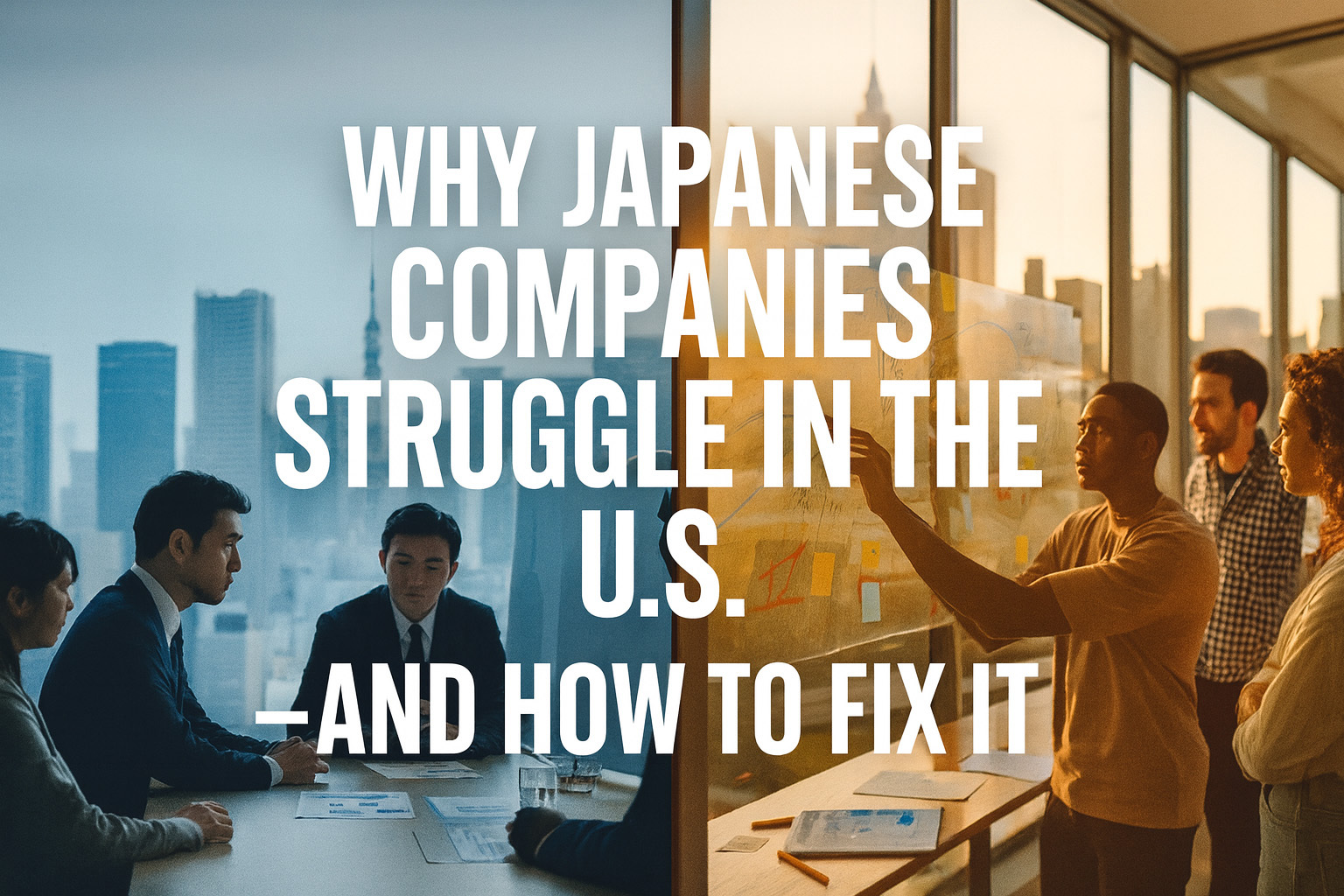
Why Japanese Companies Struggle When Expanding to America
Hello, this is Suzuki from Eco Drive.
I recently had the opportunity to stay in Japan, and it was impressive to see many businesspeople discussing the impact of the weak yen.
While “overseas expansion” can be one way to earn foreign currency, having been in the US for 20 years, I’ve seen many companies challenge the American market and then withdraw.
(To be honest, I’m one of those who has experienced this myself.)
So today, focusing on the US among overseas expansions, I’d like to discuss the theme of “Why Japanese companies struggle when challenging the American market.”
Check out the video version here!
US Expansion Is Not Straightforward
For many Japanese companies, US expansion is not straightforward.
Actually, even Uniqlo struggled greatly.
Uniqlo expanded to America in 2005.
Initially, expectations were high, and they opened stores one after another.
However, surprisingly, they didn’t achieve profitability until 2022.
It actually took 17 years.
Only a company with Uniqlo’s financial strength could survive 17 years of losses.
Other companies would have withdrawn long ago. Normally, after 10 years, they would have said “let’s quit.”
My Own Bitter Experience
I myself have experience working for a Japanese listed company and came to America with that company in 2004.
I then worked for that company in America for 10 years.
When we expanded to America, I was 24 years old.
I was a regular employee in Japan, but in the American company, I was involved as an executive from the company’s establishment.
To put it bluntly, the company didn’t achieve the results it envisioned.
It was a failure, if you call it that.
Using That Experience to Start a Business and Achieve Profitability

I learned a lot from that failure and started my own company independently in 2013.
And in the 10 years since, I’ve continued operating without a single loss.
The failure of the first 10 years became a major lesson, and in a sense, it became an answer key for subsequent success.
That’s why I’m confident that what I’m sharing today has considerable persuasive power.
Over approximately 20 years since 2004, I’ve witnessed many companies expand to America and then withdraw.
While there are companies still working hard, I feel there are common points in the areas where they struggle.
Why Japanese Companies Challenging America Struggle
I’d like to share these common points and the challenges Japanese companies face in America with you.
Based on my 20 years of experience in America and the lessons learned from failure, I hope to provide helpful information for Japanese companies considering US expansion or currently struggling.
Let’s look at five reasons why Japanese companies struggle in America, in order.
1: Success in Japan Becomes a Hindrance
The first reason is that success experience in Japan becomes a hindrance.
This applies to my own failure experience as well.
Even if you’re number one in your industry in Japan, your Japanese track record and brand recognition are completely useless in America – you often start from zero.
In America, where you’re still nobody, you take an arrogant attitude both internally and externally.
I think quite a few companies fail with this attitude.
To achieve something big in a new land, you first need to become a “villager” of that region.
New Arrivals
Discover our newest arrivals—available now!































































































The Mindset of Becoming a “Local Villager” Is Important
First, it’s important to thoroughly understand what local people are struggling with and what concerns they have.
Then, it’s crucial to capture the hearts of local people, build relationships, and gain their support.
What’s important for this is to clarify and articulate who your company is, what problems you can solve, and what value you can provide.
If you neglect this and become overconfident in yourself or your products without researching the market or competitors, you’ll face major problems.
As a result, you fall into a vicious cycle of hemorrhaging labor and marketing costs, with expenses mounting.
To succeed in US expansion, it’s essential to not be trapped by Japanese success experiences and to thoroughly understand local needs and market conditions with a humble attitude.
What’s important is reconstructing strategies adapted to the local market while leveraging your company’s strengths.
2: The Purpose and Vision for Overseas Expansion Are Not Attractive
The second reason is that “the purpose and vision for overseas expansion are not attractive.”
Many cases involve expanding without clarifying why America, what value to provide to Americans, or what problems to solve.
Particularly, if you make NASDAQ listing or NYSE listing your goal, it may not appear attractive at all to employees or external parties.
Many companies in Japan might make going public their goal, but that’s not the case in America.
Rather, there are quite a few opinions that it’s better not to go public.
I’m not denying going public itself, but going public is merely a means for fundraising, not the purpose.
Going Public Is a Means of Fundraising, Not the Purpose
While going public can be a means when you need fundraising to achieve something big, it shouldn’t become the purpose itself.
In my own experience, the Japanese company told me that going public was the goal, and I made that the goal.
In this case, when external parties ask “Why America?” or “Are you expanding just to go public?” you can’t explain.
Naturally, the company won’t appear attractive.
To succeed in US expansion, it’s important to have an attractive vision that clarifies not just going public or scaling up, but specifically what value you can provide to the local market and customers, and what problems you can solve.
That vision must capture the hearts of internal and external people and gain their support.
3: Slow Speed
The third reason is “slow decision-making speed.”
This is a problem many Japanese companies fall into.
Japan’s “Horenso” (Report, Contact, Consult) culture can be counterproductive in America.
In Japan, people who can do “Horenso” are considered capable and it’s viewed as a virtue, but not in America.
The time difference between Japan and America becomes a major factor slowing decision-making speed.
For example, if you have a meeting in America on Thursday and need to decide something, if you follow the process of creating explanatory materials, sending them to Japan, and getting approval, the response won’t come until Tuesday of the following week at the earliest.
If further adjustments are needed from there, it takes enormous time until a decision is made.
Delayed Decisions Can Mean Missing Business Opportunities

In American business culture, it’s better to avoid saying “I’ll check with the person in charge and contact you later” when key people are absent during important meetings.
If you can’t make decisions immediately, that alone could mean missing business opportunities.
Of course, if you’re a well-known major corporation in America, there might be some leeway.
However, especially for still-unknown companies, this slowness can be fatal.
In the American business environment, speed of decision-making is evaluated as a capability.
If decisions are slow, there’s a high possibility of being labeled as a company or person that doesn’t operate smoothly.
To succeed in US expansion, it’s important to understand and adapt to this “speed-focused” culture.
While Japanese caution is important, you must always be aware that speedy decision-making and action are required in American business.
Japan “Tests the Bridge Before Crossing,” America “Just Tries It”
Japanese companies tend to act only after becoming 100% certain and risks are completely eliminated, as in “testing the bridge before crossing,” but that’s not the case in America.
The characteristic of American corporate culture is the mindset of “you won’t know until you try.”
They first execute even on a small scale, verify the results, and take an approach of improvement.
In other words, they rapidly cycle through hypothesis formulation and execution.
In this culture, people who are constantly moving and challenging new things are highly valued.
And more work tends to gather around such proactive people.
While caution is important, we must not forget that speedy action of “let’s try first” is required.
Finding this balance will be the key to business success in America.
The second half of this article will be posted later, so please check it out!
You May Also Like